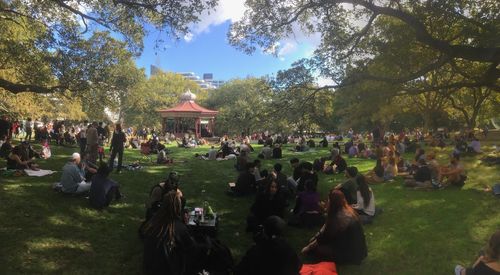
"We just kept saying yes," New Zealand Drug Foundation executive director Sarah Helm told me the evening before Through the Maze: On the road to health, where nearly 50 people and organisations were represented on the stage over two busy days.
In contrast to the foundation's last four-yearly symposium at Parliament, there was no carefully-staged policy bid and the pandemic meant that, apart from a couple of visitors from Australia, there were no marquee international speakers in the room. Instead, it was a chance for the diverse group of people who gathered to feel like a community and to reaffirm shared perspectives.
Health minister Andrew Little, the symposium's Parliamentary host, gave the opening speech. He began by addressing "the elephant in the room" – which, to his mind, was last year's referendum on a bill to legalise and regulate cannabis.
The referendum was mentioned several times during the symposium, but the minister's perception that it was somehow hanging over the event was really his alone. The sad truth is that if there was an elephant in the room, it was Andrew Little himself.
There was chatter that he might use the speech to make an announcement, or as a way to shift the policy stasis he himself had ordained. People talked earnestly about whether it would be more productive to protest, or to avoid backing him into a corner, given that he seemed to have responded so poorly to the recent open letter from multiple health and social service organisations calling for drug policy reform. There were few, if any, offstage conversations in which the Minister of Health was discussed as anything other than a problem.
In the end, there were no real announcements. It was a short speech (as someone observed to me, it felt like it suddenly ended two pages early) largely concerned with justifying the government's position. If you were to go looking for nuggets, then the affirmation that the government sees drug-checking as an everywhere-all-the-time service, and not just something that happens at summer music festivals, was one. That sounded like an acknowledgement that these services will need to be funded. It might have made it a little easier to think about a service to test green fairy products under the same law.
It's worth recalling that drug-checking was a reform that the Prime Minister effectively ordained over Little's head, after he'd declared there would be no reform for the foreseeable future about an hour after the referendum result. Nothing bad happened and there was no discernable ngeative impact on public opinion. Indeed, over a summer when eutylone flooded the market, it quite probably saved lives. The minister who declared there would be no reform ended up very happy to own this one.
Little also tossed in what might have been a revealing definition of cannabis decriminalisation – "self-use and some sharing" – before dismissing decriminalisation as an option, and there was some thought that he might have left scope for a broadening of the current palliative defence for the medical use of cannabis. The two Parliamentary journalists present checked with him afterwards: no, he hadn't.
You don't really get to present yourself as compassionate until you can logically explain why someone with a terminal condition who gains relief from cannabis is a patient, but someone with a debilitating chronic condition who finds similar relief is a criminal.
The minister said that "the medicinal cannabis regime is not yet operating as we expected" – he could hardly do otherwise – but gave an assurance there would be more products available later in the year. He may actually have strayed from his prepared text and said that manufacturers had told him so. But that is not really what local producers are telling the ministry.
Medical Cannabis Scheme a "Blazing wreck" read the headline of a release from the patient advocacy group MCANZ on the day following the minister's speech. Not a single new product has been made available under the new regime – and unless the ministry makes a third six-month extension to its transitional rules, which allow prescribers to import their own, the price of CBD products will go up, not down. Meanwhile – more in some districts than others – the police are raiding green fairies who the courts seem increasingly unhappy about punishing. It's a rolling mess.
–––
With the minister out of the way, the real symposium could begin. Several presentations stood out for me. Firstly, there were the addiction services practitioners – the humble, modestly-paid people who work at the frontline. They explained the way that there's a huge social dimension to helping people with methamphetamine problems get better: forging relationships, making connections.
Rachel Scaife of Odyssey and Lifewise talked about Haven, the drop-in support centre they opened during last year's Covid chaos, making a space for people with alcohol and other drug problems to feel safe and make a first step.
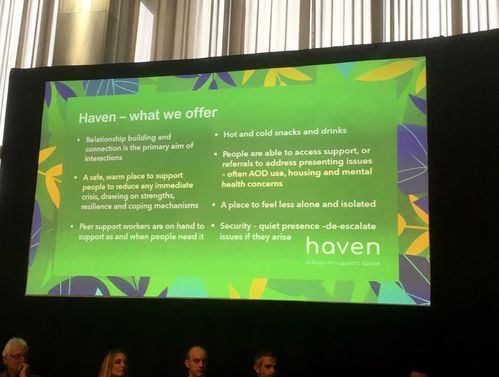
Odyssey's Andrew Munro emphasised that effective treatment for meth dependence needs to encompass families as well. The most destructive stigmatising, he said, can come from close family members. They need to become part of the process. Andrew Hopgood from the Porirua initiative New Zealand P-Pull explained why they don't make clients relinquish their gang membership: "that's their whanau".
Philippa Jones of NZ Needle Exchange revealed that her organisation has been doing work on where it would fit in to a true health-based approach to drugs: some of the services that work envisages, she observed, are simply not possible under current law – criminalisation is too much of a barrier. Even now, Needle Exchange doesn't know basic things about its client base – including how many Māori there are – because it would be imprudent to find out those things.
"Of course," she said, "if our clients weren't criminalised they might feel more confident about sharing that information."
In one way or another, each of these frontline workers made clear that criminalisation is the major barrier to wellbeing for their clients. This isn't really news – it was the clear conclusion of the 2018 Mental Health and Addictions Review – but hearing it directly from the people doing the work gave it an extra resonance.
–––
In a completely different vein, I found Professor Joe Boden's speech about the conceits of science compelling. Joe, the director of the Christchurch Health and Development Study, has his name on research that was brandished on both sides of the cannabis referendum debate last year. He was critical not only of its misuse by prohibitionists, but, remarkably, of some of the assumptions of the work itself.
Most notably, he revisited Tests of causal linkages between cannabis use and psychotic symptoms (Fergusson et al, 2005), which used data from the CHDS. It also used what now looks like a pretty bad tool for the job, or at least used it poorly.
The most commonly-endorsed items on the SCL-90 checklist used to assess potential psychological issues for the study were "I sometimes have thoughts that other people do not share" and "never feeling close to another person". If these were removed, the association between regular cannabis use and psychosis disappeared. (It's worth noting that the study was actually criticised at the time for not stating which symptoms were most reported or whether the difference in average symptom level came from a few people having many symptoms or many people having a few symptoms.)
Joe also talked about "the nomothetic curtain": the difference between imvestigating "the thing" (in this case, drug use), which is nomothetic research, and idiographical study of the "unique and contingent aspects of individuals". A focus on nomothetic approaches, he observed "can obscure what's really happening".
He said that he last year led a trajectory analysis of the same CHDS data on cannabis use. That produced something that looked a lot more like individual human lives.
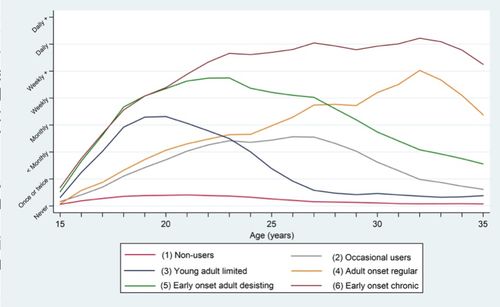
This was important, he explained, because too much research in this field assumes, through labels like "drug addict", a permanence of condition, and pays not enough attention to the dimensional aspect of any condition. That is, its severity.
"Remember there are people out there, and not just things," he concluded.
In sum, it was was an important affirmation that science is not values-free. Or to put it another way, when all you have (or allow yourself to to use) is a hammer, everything looks like a nail.
–––
Some of the ideas Joe shared were expressed more forcefully in a session on drug stigma.
Director of Māori Development at the Universty of Otago (and former Drug Foundation chair) Tuari Potiki talked about the institutional racism he experienced when he was younger ("the bias didn't seem unconscious at the time"). And how his youthful drug convictions counted for more than everything else he's done with his life when he was asked to address the UN General Assembly in New York. It took seven months to secure him a US visa and it was unclear until five weeks before the event that he'd be allowed in.
He was followed by Wendy Allison, the founder of KnowYourStuffNZ, who talked about the privilege that means her organisation gets reform allowing it to do its drug-checking work, while reform for users of other drugs – who are generally poor, non-white and more marginalised – goes missing.
Thus, we are not willing to be used by the government to show everyone how progressive they are. In fact I would suggest that tutuing about with the Misuse of Drugs Act in a way that makes privileged people safer while not helping anyone else, is not that progressive. We deserve better.
So what can we, as privileged people, do?
One thing I’ve learned from the KnowYourStuff project is the power of ethical non-compliance, and that privileged nobodies can make things happen if they have the courage. We need to use that privilege get on with doing the things that help the people in our communities who need it, whether the government approves or not.
That’s what the needle exchange did in the 1980s, it’s what KnowYourStuffNZ has done, it’s what the Green Fairies are doing, and if you’re in a position of privilege, then it’s what you should do too. Because vulnerable people die while privileged people wait around for government approval.
That might come at a cost – she revealed that she tanked an interview for a white-collar job last year by refusing on principle to submit to a pointless pre-employment drug test – but those who can bear the cost, should. That might mean coming out as one of the one in eight New Zealanders who uses illcit drugs.
I’m aware that most people aren’t in a position to take that risk, but if you are – if exposing yourself to that stigma won’t ruin your life, I encourage you to do so, even if it's only to those close to you. Change their view, let them change someone else’s.
It was, she said, "an understanding of the normality of drug use" that underpinned the effectiveness of KnowYourStuff’s practice, which had been praised earlier in the day by the minister himself.
In an environment without judgement, stigma can’t thrive - and in the absence of stigma we create space for real, honest conversations about drugs with our clients.
Without stigma, we'd be able to have real, honest conversations about drugs as a country. We’d be able to take a hard look at the actual drivers behind problematic drug use: Inequality. Disconnection. Trauma. We’d be able to talk about what actually works to reduce harm instead of always focusing on use (and by extension, users). And if we care about reducing harm, it’s our duty to make that happen.
–––
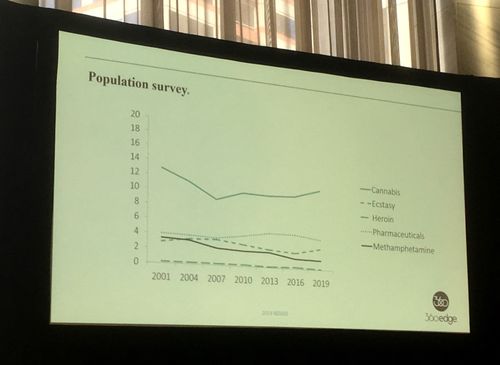
The Australian researcher Professor Nicole Lee drew a similar distinction between seeking to define success in the rate of use of any drug rather than the incidence of actual harm. She noted that meth use in Australia (they have much better data than us) has been trending down for a decade – at the same time as hospital admissions and other measures of harm are spiralling up. What, we have to ask, is drug policy for?
This is an understanding that has developed in, it needs to be acknowledged, New Zealand law enforcement. Detective Inspector Blair MacDonald, manager of the National Drug Intelligence Bureau, presented on the drug early warning service High Alert and working with "our good friends" KnowYourStuff and the Drug Foundation. It shouldn't escape us that this is a good and remarkable thing.
Perhaps invitably, he was asked whether asked whether legalising real MDMA would help quell the problem of dangerous and sometimes deadly cathinones being sold in its stead. His answer was diplomatic but clear in its way. There had been a shift in recent years, he said, in the police approach to drugs, focusing on preventing harm.
"We don't want to be the ambulance at the bottom of the cliff. That's about as much as I can say."
Noeleen Chaney of Northland DHB rattled through a lot of data on the Te Ara Oranga scheme in her region, under which police work with health providers to offer help to people with meth problems as an alternative to prosecuting them. Short version: it works. (The scheme was launched under the last National government, but I imagine would be derided as "soft on drugs" by the version of the party that festers in Opposition were it to be proposed today.)
I had an enjoyable chat with Tuari onstage at the end of the first day about the prehistory of the war on drugs as it related to New Zealand, based for my part on the history I wrote for the Drug Foundation magazine in 2014, which I think you would still find an interesting read.
Two notes from the introductory video from Johann Hari resonated: one is that our first drug law (the Opium Prevention Act 1901) was bound up in race. The other is that ever since then – through the International Opium Convention, the League of Nations, the United Nations Single Convention 1961 – we've basically been ordered around by more powerful nations. How much easier might medicinal cannabis have been if we hadn't bowed to UN instruction to stop our doctors prescribing tincture of cannabis in the late 1950s?
The story of UN pressure circles right back to America and its chief prohibitionist Harry Anslinger, who drove international policy in his country's name. We got the draconian Narcotics Act after police officer Bob Walton returned from being instructed by Anslinger's people in America and we've been trying to climb out of it ever since. Ironically, America might be climbing out faster than we are.
–––
There were some politicians in the room: Chloe, of course, and Australian Reason Party member Fiona Patten, who was a delight to meet and talk to. Labour MP Arena Williams stood out on the political panel as someone her party could and should encourage to pursue an interest in evidence-based drug policy.
But over two days of listening – and bearing in mind the mindless Parliamentary squabbles of recent weeks – I started to despair of politics and politicians. As Helen Clark pointed out, Norway's deeply considered move away from its prohibitionst past to decriminalisation is now at risk because there's an election this year and their Labour Party has decided to use that reform as a point of attack. There is no principle in that. Just politics.
I do understand, to an extent, our government's wariness around cannabis reform. Although the referendum result was very close, "Yes" didn't actually win in many electorates – and it fared badly in Labour's South Auckland heartland, where people might have been forgiven for not wanting cannabis retail on top of their problems with liquor retail.
But to declare, as Andrew Little did, that "even though the case for change is obvious", the government didn't get the "social licence" for any reform at all just defies reason. The last government was supposed to review the Misuse of Drugs Act 1975. Little himself promised to do so. The Law Commission called for a review a decade ago. How on earth does the referendum result preclude sending the damn law to a select committee to hear submissions?
There is a debate within Labour's caucus on this stalling of reform and an even stronger one amongst its party membership. Andrew Little simply does not seem to be the minister capable of steering a way through that debate – not least because he will also be stewarding a staggeringly large reform of the entire national health service. Please, just give the drug delegation to someone else.
• If the Salvation Army, the NZMA, the Mental Health Foundation, the Public Heath Association et al collectively ask you to remove the criminalisation from the use of cannabis, don't go off in a huff. Talk to them.
• Acknowledge that the current medicinal cannabis scheme has real problems. Accept that the public increasingly sees the therapetic use of cannabis in a different light to "recreational" use – there are 80 year-olds using cannabis balms – and respond to the real environment, not one that simply fits existing practice. Ask yourself: are these really the people we want to drag though court? If not, do something about it rather than relying on pissweak John Key rationalisations about police discretion. Police would welcome the guidance.
• Send the Misuse of of Drugs Act 1975 to a select committee for review. It's hard to imagine a move with less political cost attached than that.
In short, fear and stigma sometimes make good politics. They very rarely make good goverment.
NB: I was able to take a week to prepare for and attend the symposium, and to write this, because some of you contribute to that work via our PressPatron account. If you appreciated this post, feel free to click the Supporter bar beneath this post and chip in a little. Cheers, RB.