Recent Posts...
Page 31 of 32
Archive
Iraq, from the air | Apr 06, 2010 14:35
Wikileaks has released footage from the video gunsight of a US Apache attack helicopter that fired upon and killed a group of people in 2007, including two Reuters journalists. One was wounded in the first round of attacks, and when a vehicle arrived to rescue him, that vehicle was fired upon.
You can see the full video here.
It's 20 minutes long, it explains collateral damage better than anything that uses the words "collateral damage".
Please, go watch it.
It's raw, and extremely intense. But it's also much more complex than any of the 10 sec cuts you see on TV, and I implore you to be measured in your judgement.
Yes, I think that the crew and their commanders failed catastrophically, and it lead to the death of innocent people.
They failed to follow their own rules of engagement for assessing threats and risk to civilians.
They fired upon a vehicle that was evacuating the wounded, and was clearly not a military target - which was inexcusable even before considering the children onboard.
And the military lied about it.
But.
Perhaps the crew really did think that there were guys with AKs and RPGs down there. If those people actually *were* a group of insurgents with weapons on their way to an ambush, would it look different? Is it possible for this to be a genuine, reasonable, yet catastrophic mistake?
Clearly, the crew and their commanders made the wrong calls, and other people paid for it with their lives. But there is a difference between a mistake, incompetence, and murderous intent; and there's a difference in applying this to a crew behind a guy and applying this to the entire army.
Things like Wikileaks connects us directly with primary material. It has the raw power that comes from unadulterated reality. But it puts the responsibility of interpretation onto us. I hope we take that responsibility seriously.
The rules of engagement - previously classified documents also provided by Wikileaks - are available here.
Dear Gerry | Mar 25, 2010 23:00
Here are some suggestions for things you should do before you propose a policy:
1) Look at the policy's economic impact. Try using traditional measures, like expected contribution to GDP, or number of new jobs it would create. Exotic measures like "probable aggregated mass of unobtainium in entire landmass of given geology at net present value" may not be the best measure of a policy's economic impact.
2) Based on its economic impact, cost the policy and assess its impact on Crown revenue. If you are unable to find the Crown, DON'T PANIC. The Crown just means the New Zealand Government. There's a good chance that you're sitting in the government RIGHT NOW. Blow the whistle you're wearing around your neck and a friendly helper from the Crown will assess the revenue impact of the policy for you.
3) If the person that arrives is wearing a hard-hat and holding a pickaxe, THIS IS NOT THE PERSON YOU WANT. This person may be a miner, a geologist or a dwarf. The words coming out of his or her mouth are about rocks. ROCKS ARE NOT THE SAME AS MONEY.
4) If the person gives you a report with NEW ZEALAND MINERAL INDUSTRY ASSOCIATION written on the front, BEWARE! Although they both have "New Zealand" in their names, the New Zealand Minerals Industry Association is not the same thing as the NEW ZEALAND GOVERNMENT.
5) For things that affect commercial investment decisions, or have ecological or reputational impacts, you might want to consider the long-term implications. This may be many years, or even many many years. That's very many years.
6) Sometimes, your friendly helper from the government might say that there are bad things as well as good things about your proposal. Sometimes, they call these things "costs", "risks", "downsides", "negative externalities" or "bad things". Listen carefully. If they use any of these words, you should ask them to come closer and explain them to you. Once they are very close, you must to hit them in the head until they stop making any noise. Find the green civil-servant recycling cube on your desk and stuff the body inside. This will safely remove all the bad things from your policy.
7) Remember, New Zealand is a democracy. Therefore, the government debates public policy rationally. Other people who debate public policy are just batshit hysterical insane.
P is for Potential | Mar 24, 2010 23:49
Much of the hysterical noise around my modest proposals to licence P labs in residential areas is ignoring the facts about P's role in the economy.
Responsible P manufacturing is not an oxymoron, and I've made it clear that should P labs be permitted in residential areas, and should those areas show viable demands for P and low enough overhead costs, only modest and socially responsible P manufacturing would ever take place.
As for suggestions that modest and socially responsible P manufacturing on a small portion of the New Zealand's residential area would be ruinous to New Zealand's international reputation, the facts to date suggest nothing could be further from the truth.
Fact: There is already P manufacturing in residential areas
As at September 2009 there were 482 P labs already operating in residential areas. Many P labs were set up by the last Labour-led government.
Between 2000 and 2008 international tourist numbers to the country increased 37 per cent from 1,789,078 in 2000 to 2,447,208 in 2008.
You see? You see the non-linear correlation? If we had 20,000 P labs in New Zealand, we would get 100 million international tourists each year. With 500,000 P labs, every single person in the world would come to New Zealand.
Fact: P manufacturing in New Zealand is a $12 billion industry
2008 was a record year for P production in New Zealand. The industry has been growing strongly in recent years, driven by demand by that guy you went to school with who is now a giant P-head.
Fact: P is an important export industry for New Zealand
Well, okay, it's not. But that's only because of the RMA.
Fact: P manufacturing employs thousands of New Zealanders in high-paying, highly productive jobs
The P sector, including oil and crystals, directly employs about 2,000 people in New Zealand and thousands more indirectly.
Jobs in the P sector are highly productive. In the 2000-2005 period the P sector (including oil and crystals) returned an average $360,000 of GDP per full time employee, nearly six times the national average.
Workers in the P sector average an income of $60,000 per employee – over double the national average. This figure excludes contract and casual workers.
Fact: P manufacturing is far more productive than most other land applications
P manufacturing in New Zealand use an extremely small amount of land (around 100 hectares), less than 0.0015 per cent of our total residential area.
The productive value of that land is $9,623,281 per hectare. Dairy farming by comparison uses 2 million hectares of land with an export value of only $3,500 per hectare. If we converted all our dairy farms into P labs, we could buy China and pay America to deliver it while wearing a tutu.
Fact: P labs in New Zealand are New Zealand-owned as well as foreign owned
The largest P lab in New Zealand is owned by this guy on the dole, which practically makes him a state-owned enterprise.
Between 2000 and 2009 he made profits of $4.6 million and returned $510,000 to the Crown through GST on what he spent on prostitutes.
In fact NZ P rings have on average 57% local ownership compared to 43% overseas ownership.
--
As I said at the release of my discussion paper on what we're doing in the weekend, New Zealand totally wants to get high and P has an important role to play in getting high.
Whether P plays any part delivering greater prosperity, security and opportunity for all New Zealanders by way of manufacturing it is up for discussion over the next six weeks. But don't call me this week or next week, cos I'm going to be, um, real busy and shit.
(Inspired by: Gerry Brownlee and Breaking Bad.)
(Also, these numbers are completely made up. Though I reckon if you took the street value of P manufactured in a small house, the production per hectare would be pretty spectacular. Just sayin'.)
Rational, then | Mar 22, 2010 22:24
Hey Gerry. You wanted some rational? Here's some rational.
I got a little excited when the discussion document started talking about rare earth elements like dysprosium, terbium, erbium, ytterbium and unobtainium, but let's look at the actual "mineral wealth" in the conservation areas they want to open up:
Paparoa: Coal, gemstones, gold
Coromandel: Gold-silver, peat
Great Barrier Island: Gold-silver
Otahu: Gold-silver
Parakawai: Gold-silver
GERRY WANTS GOLD.
The problem is that all the reports estimate the value of gold reserves based on current prices. Why is this a problem? Because the real price of gold is currently hovering around a 27-year high (courtesy of The Big Picture):
Gold price tends to spike during times of economic (especially financial) uncertainty. Oh hey, that's us! When the boom times come back, gold prices come back down. So basically, we're digging for stuff that'll almost certainly be worth less by the time it comes out of the ground. (Not worthless, of course, just worth less.)
–
And Gerry pulled out this line again (his stock line when talking about mining):
It's also worth noting that in productivity terms, workers in the mining sector return an average of $360,000 of GDP per worker, nearly six times the national average."
Wow, $360,000, that's *heaps*! If we were all miners, we'd all be rich!
No.
Here's what Gerry did. He took the total worth of the mining sector, then divide it by the number of people it employed. It does not mean that more mining = higher productivity. It just means that mining is very capital-intensive and employs relatively few people, which are fairly obvious facts.
The median income for wage and salary earners in mining in 2008 is actually $57,660.
The "output per worker" ("$360,000") is very high because most of the output comes from a) large expensive machines produced by other countries and b) the ground. The worker is not a highly valuable nor highly valued part of the process.
Sure, mining could become a cash-cow for the government, but the kind of "productivity" that Brownlee's talking about does not lead to improved quality of life for New Zealanders. (Unless you're a New Zealander who owns a mining company.)
To be fair, from what I can tell, 80% of mining firms are majority NZ-owned. That's not to say that new entrants into the market will also be NZ-owned, but the characterisation of mining companies as evil multinationals is unfounded. If they are evil, they're locally-owned evil.
–
This just seems like such a giant leap backwards. We've spent so many years talking about the knowledge economy, moving up the value chain, selling ideas and knowhow rather than soil nutrients... and now the vision for a more productive New Zealand is digging shit up and cashing it in?
We know exactly why we can't rely on the primary sector in the long-term. The more you squeeze out of the land, the harder you need to squeeze to get the next dollar out. It means that growth becomes harder, and we've said for years that moving up the value chain – agriscience, biotech, etc. – was the way forward.
Value-add! Innovation! Selling ideas! This was what "ambitious for New Zealand" was supposed to be about, right?
So what the hell is this?
--
Check out this great piece yesterday by my friend Chye-Ching Huang on the plans for a New Zealand Productivity Council.
--
(Also, using "conservation fund = $2-10m over four years = 50% of royalties" to estimate how much the government stands to gain is deeply unreliable. The $2-10m figure is just an arbitrary cap, and there's nothing to suggest that royalties will *actually* be within this range. My bet is that the revenue impact estimate of mining royalties is currently "mehdunno". OIAing this now...)
Property Investment Federation: Just STFU | Mar 12, 2010 02:30
Let's not beat around the bush here. The Property Investors Federation is full of shit. Completely and utterly full of shit.
(Dear Lawyers, I do not mean literally "filled with faecal matter" as a statement of fact. I mean "full of shit" figuratively, which I am confident will be considered honest opinion – as in "honestly, it is my sincere opinion that they are just figuratively full of shit" – under defamation laws.)
Yesterday, 11 March 2010, TVNZ reported:
The Property Investors Federation estimates that, on average, landlords could miss out on $1,750 a year by not claiming depreciation. This works out to be approximately $34 a week. It is believed most of that will be passed on to tenants."
On 20 January 2010, the Federation said in a press release (emphasis added):
Many rental property owners have purchased their property on the basis that they can claim depreciation as an expenses but that they will have to pay this back should they sell at some time in the future. Depreciation claims by rental property owners help them to keep the cost of renting lower, especially in the first few years of ownership. If the ability to make depreciation claims are withdrawn from rental property then many owners will be forced to sell their property as they will no longer be able to finance them."
So, two months ago, deprecation wasn't real money because they have to pay it back. But now, they forget about the fact that they would have had to pay it back, treat it all as a cost and say that tenants will be paying for it.
Full. Of. Shit.
--
This is the public service part. This stuff really, truly belongs with the tax nerds, but I guess this is why property investors have manage to rort the system for so long. It's no fun, but hopefully this actually explains what the issues are behind the "debate".
How depreciation changes will affect rent needs to be broken down into two parts: a) How much it'll actually cost landlords, and b) How much of this cost will be passed to renters.
Here's how depreciation works:
* You take the value of your house (just the building, not the land). Let's say, for ease of calculation, the building is worth $100,000.
* Each year, it depreciates by a set amount. So, if the depreciation rate is 3%, then you have a depreciation of $3,000.
* Your house's is now worth $97,000 on paper, but you can claim this $3,000 "loss" as an expense so you pay less tax. Let's say, $1,000 less tax.
But here's the kicker:
* If you sell your house $100,000, but it's book value is $97,000, then the IRD sees that the depreciation wasn't real, and makes you pay back the $1,000. This is called depreciation recovery or clawback.
In theory, depreciation isn't free money. Either it's real, in which case the property owner actually lost value, or it's not, in which case the owner has to pay it back (but gets to keep the money for a while, like an interest-free loan).
Losing $3,000 of deprecation may just mean "losing $1,000 of tax credits that I'd have to pay back in 10 years anyway". So to take the face value $1,000 and say that "this is how much landlords will have to hike rents to not have to sell their children" is misleading.
(In practice, you don't sell the building and the land separately, and you don't get taxed on capital gains on the land, so you can put all the depreciation on the building and call it a loss, and put all the gains on the land and not pay any tax on it. But it takes a bit of creative accounting and there are limits, so it's not a rort-buffet.)
The more important point is that landlords aren't feudal lords. If their costs go up (or their profits go down), they can't just say "well, screw that, let the tenant pay for it". People have choices. If landlords choose to hike their rents, people can choose to live with their parents, move in with flatmates, leave the country, or buy a house. Fewer people in the rental market will push rents back down again – even for people who can't move in with parents/flatmates/leave etc.
Put it this way. If landlords could really make their tenants pay the full cost of the changes, would they really be bitching about it so much?
–
Of course, this means Trevor Mallard's own back-of-a-napkin adventures were even more full of shit.
My calculation is that the average residential rental property will inolve [sic] a loss of about $45 to the landlord v current depreciation arrangements.
(Average house price 416k but I've used median 360k. 2% depreciation = $7,200. 33c tax rate = $2,400 say $45 per week)"
As he acknowledges in his update, he included land values, so he massively overstates the cost, and he didn't even consider clawback. The curious thing is how his clearly, completely and massively wrong estimate ended up being in the same ballpark as the Property Investors Federation's completely unsubstantiated figure...
Oh. Right.
Full. Of. Shit.
Tax cut zombies | Feb 10, 2010 09:58
Dear DomPost. Your headline today, in very large letters, said "$4b in tax cuts coming".
People might read that, and think that there are $4b in tax cuts coming.
Except that it's $4b in tax cuts, funding by $4b in tax hikes.
Lemme do the maths for you.
$4b - $4b = $0
$0. That's what "revenue neutral" means.
Has half a decade of mindless calls for "taaax cuuut... taaax cuuuutss..." rotten your brain so much that you're starting to see tax cuts everywhere you look? Does your cat look like a tax cut to you?
Updated: GST compensation: Can be done? | Feb 09, 2010 16:06
John Key's promise to compensate low-income NZers for changes to GST is one he's unlikely to keep.
[RETRACTED! Actually, as Neil Russ points out to NZPA, the changes to depreciation rules are enough to fund the rates alignment by itself. Which means that, in theory, all the money raised by raising GST could be used to fund a tax cut on the bottom threshold.
Which begs a much more interesting question: Will he?]
TWG estimates upping GST to 15% will be worth $2.89b. 35% of this will be borne by the bottom 50% (by income) of the population.
This means that the bottom 50% of the population will have to pay $1b more in GST.
That's the goal post for Key's promise.
Key has ruled out changes to Working for Families. But tax cuts have a smaller impact on people with low income, so to deliver $1b via the tax system, it'd require a much bigger tax cut across the board.
To offset the impact of the GST increase to the bottom 50%, he'd have to slash the bottom tax rate in half (to around 6.7%, to be precise), or introduce a $6000 tax-free threshold.
But either of those measures would extend to the top 50% as well, and it would cost a lot more than $1b. In fact, it would eat up most of the revenue from the GST hike and leave little to fund the reduction of the top tax rates - which was the point of the whole exercise.
Sure, it *could* happen. But a much more likely scenario is that the compensation will fall far short of the actual impact of the GST.
If you want to verify the $1b for bottom 50% figure, see table 2 (page 2) and figure 5 (page 7) the GST paper prepared by the TWG.
[Update: Yes, the GST paper discusses compensation options, specifically, CPI adjustments for many benefits that will automatically kick in if GST goes up. However, that won't do anything for people not on benefits, which is quite unfair. (Haven't really thought through EMTR and such yet, but that depends on whether abatement thresholds and such are CPI-pegged too. Meh. I'm sticking with "unfair" for now.)]
We hold these truths to be self-evident | Feb 09, 2010 10:12
... that setting $1.3 billion on fire would be harmful to the economy and the environment.
The last "king hit" from the Property Council is a report they commissioned NZIER to write, which talked about all the ways in which the tax changes are bad.
The first footnote of this report states:
Our analysis looks at these policy suggestions in isolation and not in the context of potentially offsetting policies."
As in, it looks at how taking $1.3b out of the economy would be a bad thing, then assumes we throw the $1.3b into a very very large barrel, dose it in petrol and set it on fire (cost of petrol also excluded).
Yes, this would be harmful to the economy. I wholeheartedly agree.
Thank you Property Council, thank you.
Lies, damn lies, adjectives | Feb 08, 2010 14:15
The vicious lynch mob gathers angrily. They menacingly surround the industrious elderly folksy old folks, who were frugally baking nutritious cookies for the respectful local children in their bespoke bungalow in a well-to-do suburb with stunning views of the luminescent harbour.
"Argh," the vile leader of the listless mob shouts melodiously with venomous vitriol, "we're gonna make you pay… pay taxes! Argh!"
--
"As the vitriol builds against property investors it's becoming increasingly clear that there will be many innocent bystanders injured by the mooted changes to tax law."
Let's just clarify some points here:
• "Hang 'em all!" (Vitriol.)
• "Put the capitalist pig-dogs against the wall!" (Vitriol.)
• "Make them pay 0.5% on unimproved land value and remove exemptions on depreciation!" (Not vitriol.)
The property investment industry has been putting up a noble fight since the Tax Working Group report came out. They're not fighting for themselves, they're fighting for the hardworking elderly folk who've scrimped and saved all their lives, and who will struggle to get by if these punitive measures enacted against them.
David Chaplin cited chairman of the AMP NZ Office Trust Craig Stobo's concerns in his column last week, describing him as "no particular friend of tax-deducting landlords and in his past life as head of BT NZ funds management he no doubt railed against the residential property sector."
"The burden of these proposed taxes is therefore going to be borne by investors who have taken steps to provide for their future, and the businesses which are providing jobs for the current generation of workers - neither of which have much ability to absorb new costs in the current economic environment."
Chaplin glossed over the fact that "AMP NZ Office Trust (ANZO) is New Zealand's largest listed investor in commercial office property and owns arguably the country's best office property portfolio."
It is an utter misrepresentation of what Stobo's interests are. Far from being a fund manager in some kind of "funds" vs "property" dichotomy who's reluctantly against the tax changes for reasons of principle, he is the head of a massive property investor with a very direct and very large commercial interest to fight the changes.
And the quotes that he takes from Stobo are meaningless PR drivel anyway. When I go to the dairy to buy some milk, I don't call it "taking steps to secure my future health and wellbeing". Currency is a store of value for use in the future, so by definition, everyone who invests – and for that matter, everyone who works for money – are "taking steps to provide for their future".
His investors are special only because they benefited from – or foolishly bought into – the price bubble created by tax exemptions. It doesn't make them bad people, but it does make them bad investors. They're not being punished for it, they're just not getting bailed out.
And then, there's the money line from Stobo – from the same playbook that the property industry has been reading off since the TWG report. Focus on the old people. It's all about grandma. Never use the words "my" or "profit".
"Listed property is an investment which is particularly popular with older investors, who are already finding it tough in this economic environment and depend on regular income from their investments,"
So, because some of his investors are old people, therefore we should not tax him. Hmmm. Drop the tax changes, or the old people gets it?
If this is true – that many old people are dependent on income from property funds – then it leads to a much bigger question. Why are they dependent on one asset class in the first place? Weren't there people – anyone? – who warned them that all eggs in one basket was a bad idea?
A single change – e.g. Tax – affects every asset in the portfolio. Capital gains tax or any of its alternatives would have hit the profitability and value of property investments. Did the media, financial advisors and funds themselves responsibly acknowledge this risk? Because if the consequences of this tax change is really as catastrophic as you fellas suggest – and this tax change has been foreshadowed for so long – then how much fault falls on your shoulders?
Table 6.2: 'Rich pricks' & Others | Jan 18, 2010 10:34
So the top 1% of taxpayers pay 15% of the tax, and the top 3% pay 26% of the tax? Does it mean we overtax our rich?
No, and I'm sick of writing about it. So, here are some interactive pies I prepared earlier. The angle shows income distribution (the broader the slice, the greater their share of the total income). The area shows tax distribution (the bigger the slice, the more they contribute to the total pool of income tax). If this doesn't make sense to you, compare the NZ graph with the equal income and flat tax graphs. Under a flat tax system, it looks like a normal pie graph, so all the distortions show the progressive tax system at work.
You can also click on each slice to break them down further. (Click outside the pie to zoom back out.) You need Flash to see this properly. You can get Flash here
The points are:
* Rich people have a very big slice mainly because they have a very broad slice. That is, they pay a lot of tax because they make a lot of money. Duh.
* Rich people get taxed more on their income (their slice sticks out more). That's because we have progressive tax systems. Duh.
* How progressive? At the top end, New Zealand's tax system is less progressive than Australia. Rich pricks in Australia pay more than they do in New Zealand, both proportionally and in absolute terms.
* At the bottom end, New Zealand's tax system is *far* less progressive than Australia. If you zoom in to the bottom 50% (i.e. Click on it), you'll see that Australia curves in very quickly – that's because the first $6,000 of income is tax free, which means that poor pricks pay very little tax.
* On top of this, Australia's bottom 50% have a bigger share of the total income. This is not a tax issue, nor about the income disparity between New Zealand and Australia. Income is more equitably distributed in Australia, even before tax is taken into account.
It's not some kind of tricky accounting. Australia has a tax-free bottom bracket, and at the top end, it goes all the way up to 45% (New Zealand's top rate is 39%). Australia's tax system is simply more progressive. This means it's low income earners who have a tax incentive to move to Australia, and 'rich pricks' who don't.
This idea that the brain-drain is all about (or anything about) tax is just crap.
The other claims about New Zealand having an uncompetitive tax system are tougher to unwrap.
Does NZ have the third highest rate of personal tax in the OECD? Sure, if you don't count social security contributions. What social security contributions? Oh, right, New Zealand doesn't have that because we just pay it – i.e. Fund the welfare state – out of normal taxes. People in other countries pay a separate social security "tax", a bit like the way we pay ACC separately.
It's a big chunk of the bill – when you include it for some countries and not for others, it's an entirely skewed picture, and doesn't represent what people actually pay, and what they take up.
Likewise, when our corporate tax rate is compared with other countries, it's never really comparable. Sure, we have "the third highest rate of corporate tax in the OECD", but we also give these things called imputation credits. They're coupons for tax that's already been paid, so that shareholders get credit for tax that the company has paid, and don't have to pay it again.
Other countries don't have imputation credits clip half the tickets on each end – once when the company earns a profit, and again when that profit is doled out to shareholders. Of course, when you just look at this system and count half of it, New Zealand's rate will seem high by comparison.
So, does it mean that we should have a more progressive tax system? No. It means we should stop drawing simplistic conclusions from one-line statistics in op-eds.
Grump.
Notes:
* The graph uses 2007 IRD data because I could only get 2007 data for Australia, so it will be slightly different from the op-ed, which cites 2008 numbers, I think.
* I was going to put UK stats in there as well, but they've aggregated their stats into a handful of very large brackets, which means it's impossible to extract accurate information on a granular level. If anyone has it (i.e. UK income and income tax distribution broken down by percentile, or by small income brackets) and don't mind sharing, I'd love to chuck it up too.
* This was going to go up two weeks ago, but the visualisation took longer than expected, and then Google vs China kinda took over. Here's the interview with Wammo:
Google to Embargo China | Jan 13, 2010 22:27
Current status @ 07:20 NZT, 02:20 Beijing time, 14-01-10: Still conflicting reports coming out. It could be that Google has already lifted its own censorship measures. Or it could be that the censorship measures are still up, but because of the intense interest generated (and click-thrus) on sensitive subjects, small holes in the wall are being publicised and magnified.
It doesn't matter any more: People are getting through the wall.
However, being visible on search results doesn't mean that they can access the sites. But it's still a big deal.
Status @ 23:30 NZT, 18:30 Beijing time, 13-01-10: Heaps of reports of uncensored stuff. My post below may not be accurate. The images below show massive differences between google.cn results and google.com.hk results. The difference may be just a residual effect of the censorship - because Google ranks stuff based on links, previously censored materials may still be poorly ranked, even though they're no longer censored.
And now, watching and waiting to see when the site will go down. Why *isn't* it down?
Status @ 22:30 NZT, 17:30 Beijing time, 13-01-10: Despite reports to the contrary Google.cn is still censored.
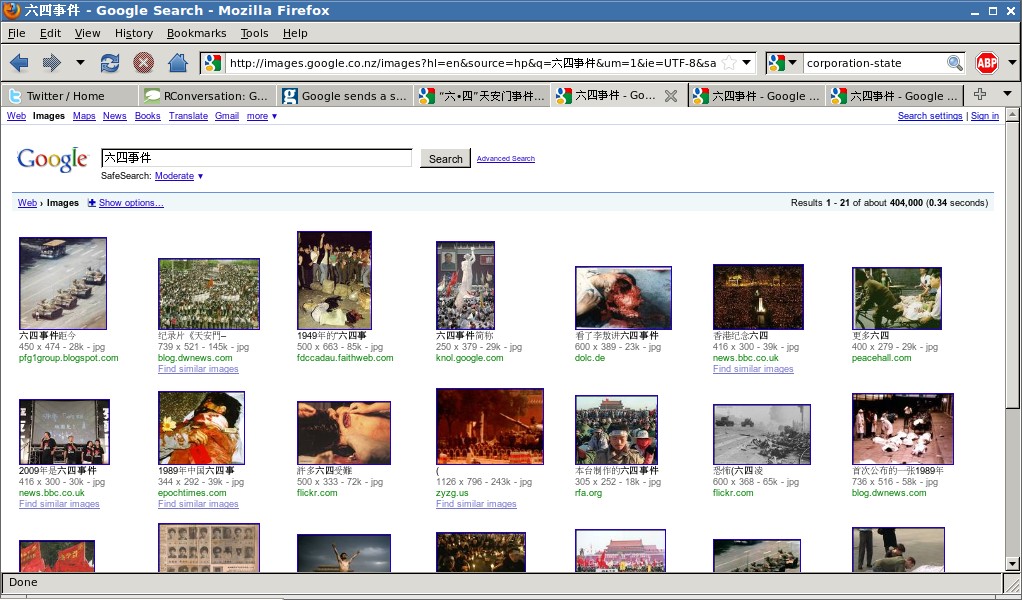
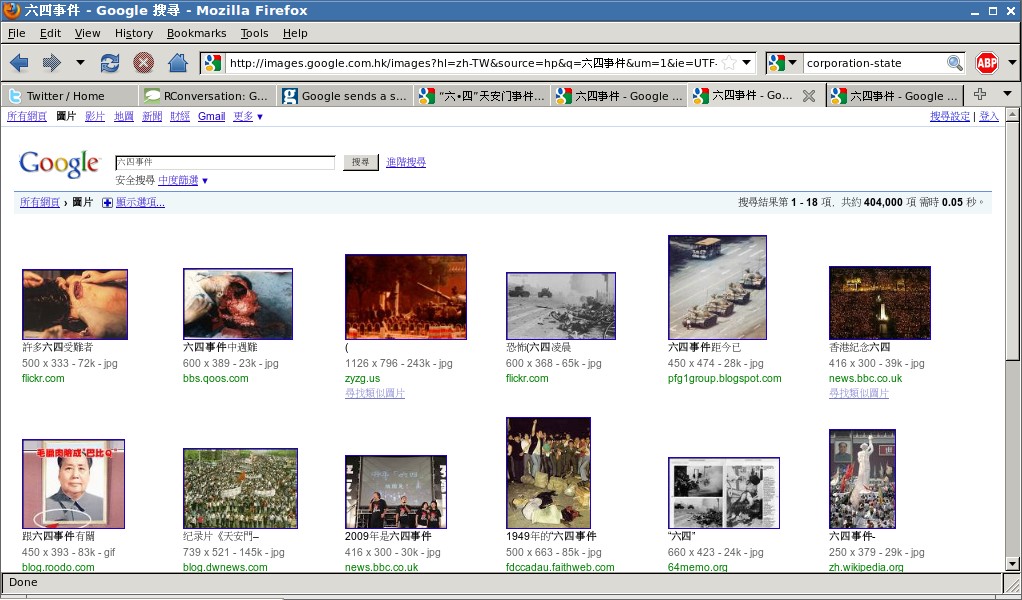
Here is the results of a Google.cn image search for "六四事件", or "6-4 incident", which refers to the Tienanmen Square massacre, which occurred on 4th of June, 1989.
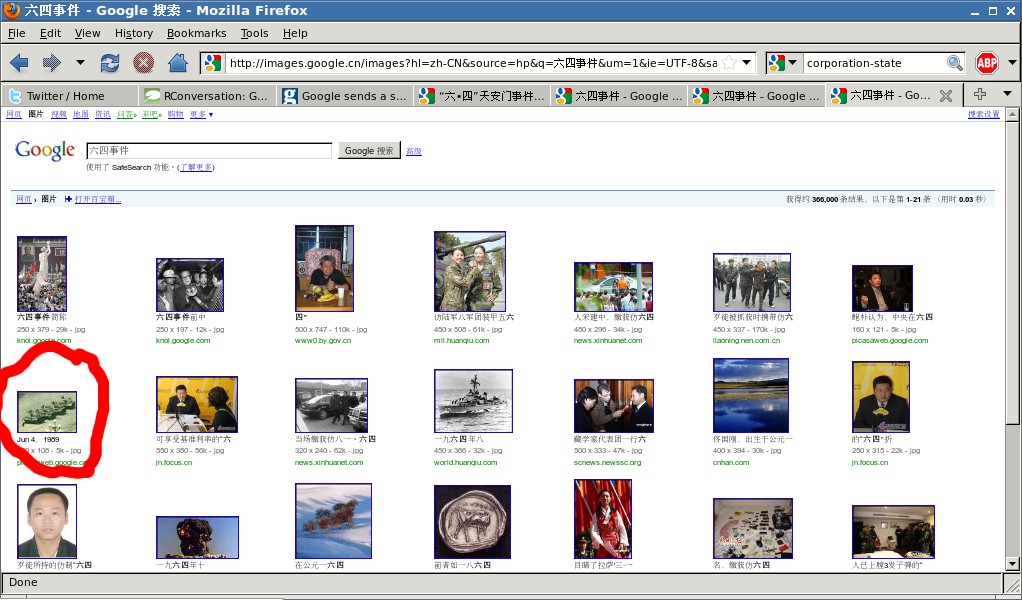
And here's the results from Google.com.hk and Google.co.nz for the same term - WARNING: Disturbing images follow.
--
Remember about, oh, a decade ago? Before 9/11? After the Battle of Seattle, when everyone was talking about multinational corporations taking over the world, about corporate states and all of that?
Yesterday, we officially tripped over this point in history.
Take a step back and consider the situation: Google is threatening to embargo a superpower, in retaliation for an espionage campaign.
I mean... holy fucking shit.
Unlike, say, the East Indian Company, it doesn't have a navy or an army. It doesn't control the food supply, have significant land holdings, raw resources, or industrial base. It doesn't have vast numbers of employees, it can't hold the financial system hostage.
It doesn't even control the internet.
All our expectations for how these companies would project their power was wrong.
Only a small part of the threat is economic. Sure, Chinese businesses might not do as well if they couldn't deal with Google, but dealing with local search leader Baidu, or Microsoft, or Yahoo, that's hardly going to cripple the economy.
The truth behind Google's threat is best summed up by this line, which was floating around on Twitter:
"It's not Google leaving China, it's China leaving the world."
不是谷歌退出了中国,而中国退出了世界。
We've always thought of companies as having to buy their way to power. After all, they are defined by money. But multinational corporations have finally taken their place in the spotlight of world affairs (instead of pulling strings all the time), and it wasn't with money.
Google represents access to the internet. So by proxy, it represents Everything. When China had a full buffet of Google, and Yahoo and MSN and Baidu, it could maintain the illusion that people really had access to Everything.
If Google takes itself off the table, it will become clear that they don't, and that goes to the heart of the social contract between the Chinese government and its people.
It's soft power of the abstract, symbolic kind.
--
A few quotes from Twitter:
"It's not Google leaving China, it's China leaving the world."
不是谷歌退出了中国,而中国退出了世界。
"Illegal flowers, illegal loitering, illegal web surfing. When the word 'illegal' is abused like this, that's the day when the dignity of the law is stepped on."
非法献花、非法逗留、非法上网. "非法"二字被滥用之时,就是法律的尊严被践踏之日
"Google withdraws from China, signalling the four big international websites' (Google, Facebook, Twitter, Youtube) complete defeat; anti-Chinese forces have met with huge failure in China, once again proving the undefeatable power of the great, glorious and correct Chinese Communist Party."
谷歌退出中国,宣告Google,Facebook,Twitter,Youtube四大国际网站全面溃败,反华势力们在中国遭遇了巨大的失败,再次证明伟大、光荣、正确的中国共产党战无不胜的能力
(Swear to god - that's an honest translation.)
Angry Fisk of Rightwing Thinktank for Entertainment Purposes | Jan 13, 2010 17:09
Dear Dr Oliver Hartwich, research fellow at the Centre for Independent Studies: You, sir, are a grossly ignorant douche.
It's a nice concept for an op-ed, the idea that the pornography industry is a hotbed of innovation. It must have even seemed nicer, when you had the genius idea of attaching "social improvement" to the end of that sentence. It allows you to talk about porn, *and* about how every slither of capitalism is awesome.
Shame that you don't know what you're talking about.
On Monday the [Sydney Morning] Herald reported from the Consumer Electronics Show in Las Vegas where 3D porn was the hot issue for technology geeks this year. A porn actress, who had just starred in one of the industry's first 3D films, was quoted as being ''very excited'' to pioneer this new field. She should be. Once again, the porn industry turns out to be a force for good - unintentionally.
Schools will use new 3D television techniques to teach. Imagine how geography lessons will come alive if classes can virtually wander in faraway places using 3D glasses. Physics and chemistry experiments too dangerous or complicated for classrooms could also be shown on a 3D screen.
You know that 3D television is just an optical illusion, right? If there's a 3D porn star facing you on the 3D television, you can't go behind the TV and see her ass. Likewise, 3D glasses won't allow you wander virtually in a 3D world. An ability to explore in the third dimension requires the information to be stored in 3D. Such technology won't be available until well into the distant future, in a world where America has a black president, and where electricity is as common as running water.
Did you even Google "3D maps"? What decade are you living in that 3D maps have to be "imagined"?
And have you even been to school? What kind of physics or chemistry experiments are better understood with 3D video than with 2D video? Is looking at a beaker in 3D more informative than seeing it in 2D? Are you going to illustrate projectile motion experiments with "OMG – it's coming right at you! (thus making it virtually impossible to see what it's actually doing)"?
If experiments are too dangerous to perform in schools, how can students see them? WITH VIDEOS!! BECAUSE THAT'S WHAT 3D VIDEOS ARE. **VIDEOS**!!
Christ.
Before you and your thinktank declare 3D television to be porn's gift to children, you ought to have a clue about what it actually is. 3D television adds fake depth perception. So does drawing shadows and shades. It's pretty cool as an experience, but it adds very little information.
Should the parents of the future wish to thank the brains behind these teaching improvements, they would be surprised. Far from being the result of some philanthropic engagement, the new technologies will have been conceived not in an ivory tower but as a byproduct of the sex industry."
You, sir, are just plain making shit up.
Do you have any factual basis to claim that 3D television is somehow there because of the porn industry? That it was even developed by the porn industry?
The porn industry buys 3D equipment. Great. But rather than crediting people who use the technology with its development, perhaps you should credit the people who developed the technology for its development? Maybe? Just a little?
You've given porn credit for a technology that it didn't invent or create, you've claimed that the technology can do things that it can't (while other technologies have been doing those things for a decade), and then you've claimed that because porn brought such miraculous gifts into the world, and because it's greedy, therefore greed is a bringer of gifts into the world.
No, I think you've just made a case for greed being 3D.
And then, you said:
That lazy government officials could be preferable was demonstrated nicely in Hong Kong. When it was still a British crown colony, its financial secretary, Sir John Cowperthwaite could not be bothered collecting extensive statistics; he just kept taxes low and regulation to a minimum. Whether this was genius or just plain laziness, it definitely helped to make Hong Kong one of the most prosperous places on the planet."
Maybe the massive influx of capital, skilled and unskilled labour was significant too? Maybe people didn't move to Hong Kong for the low taxes and the liberal regulatory regime, but for the absence of a civil war and a cultural revolution? Maybe? Just a little?
Dr Oliver Hartwich, research fellow at the Centre for Independent Studies, you and your organisation claim to champion innovation and enterprise, but you show utter indifference to the science, technology and reality on which innovation and enterprises is built.
Or, you're a mole who've just done a fantastic job of discrediting the CIS.
Page 31 of 32
Archive