Recent Posts...
Page 29 of 31
Archive
How it would work | May 14, 2009 22:10
"And... mark."
"Who?"
"I said mark."
"Mark who?"
"No, you synchronise your watch when I say mark."
"Is he, like, a watch guy?"
"Who?"
"Mark."
".... Just remember that we only have one shot at this and if we don't do it in the next twenty-two minutes, we'll never have the chance again. You remember your job?"
"Yeah."
"You got the crowbar?"
"Yeah."
"Did you check the gas?"
"What?"
"The gas. The gas on the torch."
"Oh. Yeah."
"That one."
"What?"
"That one."
"What?"
"You're in the wrong lane."
"What? That's the..."
"You're in the wrong lane!"
"But that isn't our..."
"It's that one! Oh, man! Oh! Oh! Oh, man. Oh! You just missed our exit!"
"Should I turn around?"
"It's a motorway. There is nothing we can do. This motorway has ruined everything."
"Oh... do you want to go to the North Shore instead?"
"No, no. I just want to go home."
"But good thing there're no tolls, eh?"
Let it die. Please. | May 12, 2009 04:26
I haven't given nearly enough thought to the relationship between Farrar and the National Party comms machine, nor to the role that he plays in testing, seeding and propagating National Party messages. But it's impossible to look at this indecent assault on numeracy and not think that it's a lightly paraphrased briefing paper written by a policy-cum-comms hack (Research Unit?) outlining the key messages that National wants to get out ahead of the Budget.
The main thrust of it seems to be trying claim that Labour's tax cuts are just as bad as National when it comes to favouring the rich. Here, DPF relies on one really straightforward trick: Picking sample points that distort the real picture.
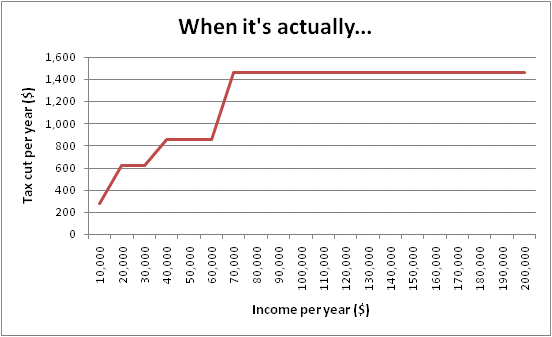
He says that those on $30k get $620/year, those on $50k get $860/year, and those on $100k get $1460/year. So, the richer you are, the more you get, right? It implies a line that looks like this:
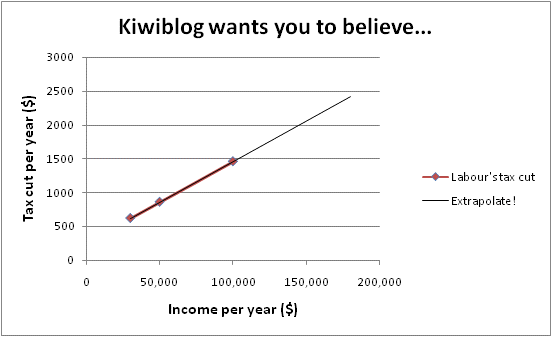
Well it's not. It actually looks like:

It shows that a) Everyone earning $70k/year or more gets $1,460 in tax cuts – not just people earning $100k/year, and b) nobody gets more than that, regardless of income. Compare that with National's tax cuts, which scales up with income.
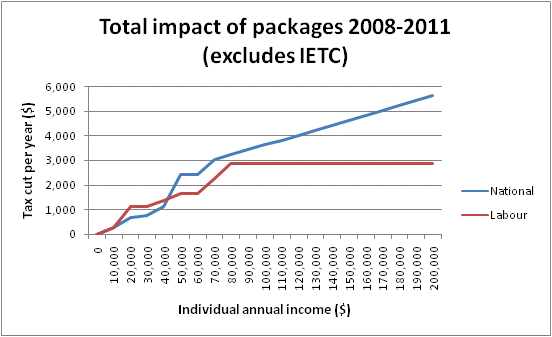
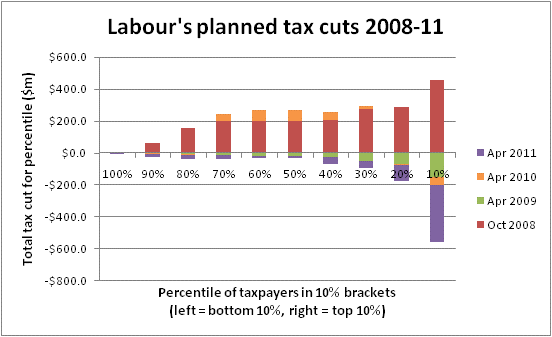
But this is all meaningless information when we're talking about the entire population, rather than one person. To understand how the package is structured and where the money is going, we need to incorporate data about who pays tax. So, here is one I prepared earlier, showing who would have benefited from Labour's tax cuts:

Each bar represents 10% of taxpayers, sorted by income. The bottom 10% is on the left. The top 10% is on the right.
The parts below the axis represent tax increases – the effect of wage growth plus fiscal drag – you know, the stuff that the Right loved to talk about so much last year? Cullen's tax cut was designed so that the increases to the upper threshold would be recovered (i.e. Back to what it was in 2008) by 2011.
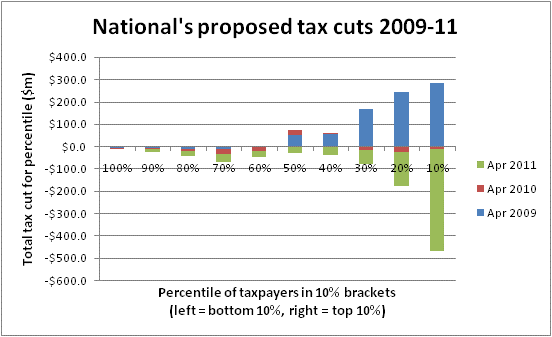
By 2011, the middle 50% of taxpayers would have had the greatest net gain from tax cuts. Compare this with National's tax cuts.

National April 2009 package was entirely weighed towards the top 30% of earners. The only thing that the next 20% get is Independent Earners Tax Credit – Treasury assumes that around half the taxpayers in that bracket are eligible. The bottom 50% get nothing from National at all, and will be paying more in tax every year.
The top 10% sees most of their tax cuts wiped out by wage growth and fiscal drag – but remember, the 2008 tax cut had already wiped it out, so National's tax cut comes on top of that.
--
Their other line is that National's tax cuts is a good response to the recession.
The New Zealand Institute's latest report, Not just a case of a passing 'Recessionary Flu' doesn't beat around the bush on the issue:
…the next two tranches of the proposed income tax cuts should be cancelled on the grounds that they would contribute to the structural deficit, are unlikely to do much for growth, and do not support the most vulnerable households. Very few of the benefits of these proposed tax cuts flow to the most vulnerable families during the recession: most of the benefits accrue to upper-income households, and the cut that reaches furthest down the income scale (the proposed reduction of the 21 percent marginal tax rate to 20 percent) is not scheduled to take effect until April 2011. Nor are these tax cuts especially well-designed for growth creation, with the top marginal income tax rates left virtually unchanged (marginal income tax rates having significant incentive effects on individual work and production choices)."
Half the equation is that it's just not very good at stimulating economic activity.
The other half is that a good stimulatory response is supposed to pump money into the economy as quickly as possible, then recover it when the economy is in better shape.
The next two phases of tax cuts does the exact opposite – it's an arse-loaded stimulus package. The cost of cutting the top rate (in lost tax revenue) actually increases with time, but has the least stimulatory impact in the short-term. Delaying it will make it even more ridiculous, since the long-term cost stays the same, but its stimulatory value decreases further.
Instead of short-term, immediate spending, or even one-off tax refunds, National wants to implement tax cuts that actually become more expensive with time, and they wonder why there's a looming structural surplus?
This tax cut grew up in a more innocent time, when "Supersize Me Surplus" was a derisive term, when trying to get rid of the surplus was an actual, stated priority, when you had every editorial writer and columnist in the country backing you on it for no goddamn reason, and when you could actually get away with it.
It should go back there and die.
--
Kiwis should dismiss Michael Cullen's protestations that the surplus is not real." (John Key, 18 May 2006)
Plague, Famine, By-Election | May 11, 2009 02:29
Small towns cut off from the outside world by an earthquake which also releases swine-flu-spitting zombies from an interdimensional portal to hell have fewer problems than Mt Albert, apparently. (Fast-moving zombies, FYI.)
Shearer and Norman's visions of doom sees Mt Albert being sliced in half by a motorway then annexed by John Banks. And because National has nowhere to go on the motorway, Lee's found herself a winner with law and order: "Just look at what happened in Napier."
Because… you know… there's crime in Mt Albert… and there's crime in Napier… which means that… crazy gunman is… crime… bad… and vote National.
Sigh. All these hoardings and slogans are triggering my PTSD. (I huddle in a corner and mutter: "Sell, iPredict, for the love of god, sell!!")
Adding to the deja vu, John Boscowen brought his box of puns from last year:
No More Buy-Elections."
I laughed. Still, it's kinda ungenerous of him to say that spending money to avoid bulldozing 600 houses is "buying votes".
The Greens are the last one off the starting block with their campaign launch today. They're bringing out the "Vote for Me" campaign that everyone fawned over last time, but shot in authentic Mt Albert locations, with presumably authentic Mt Albert kids. Mixed in, rather awkwardly, is a new ad:
Get more muscle. Vote Russel."
Ahem.
The point of difference they're trying to push is that Norman is a party leader – why, just like Helen Clark! – and therefore he'll have more muscle with which to fight for his electorate.
He cites the Greens' negotiations with National over the more "Orwellian" changes that they wanted to make to the RMA, but more interestingly, he points out how the Mt Albert electorate MP can actually put a very large spanner in the works:
I think on Waterview there's going to be a long battle in the community against the government about it. Cos these major motorway projects, they just end up locked in the community for [inaudible]. We saw it in the Eastern Motorway, which ultimately failed. The community can take on the government and win."
I found it particularly interesting because it shows what a hole National has dug for themselves on Waterview.
Instead of the tunnel option, which already has substantial community buy-in, they want to opt for an option that is much worse than one that was soundly resisted by the community. Of course the community will fight them at every turn.
For the business community, this is going back to square one, with a high degree of uncertainty around the project. If the government saves $800m (just a guess) by bulldozing through Mt Albert, but the project gets dragged out for another five years while congestion continues to get worse, will business leaders think it was a good move? Will anyone?
--
An idea that floated around the campaign launch today was to cost public transport options to see what kind of public transport alternative Waterview could buy instead. Would be great to see how they stack up…
--
The worst part about this by-election so far is the candidates attempting to present their bona fides as Mt Albert residents. The fact that they frequent local shops and can name local landmarks is very nice, but if that's one of the top ten things they have going for them, they sure as hell wouldn't get my vote.
Lee really needs to stop apologising for living on the wrong side of the electorate boundary. And Shearer was in friggin' Bagdad. He doesn't need to be excused for shit.
While I'm at it, it was quite heartening to see him take the "private armies" stuff on the on chin. So he wrote a rational argument a decade ago justifying a position that is against party policy today. So he disagrees with the party on an issue. "Yeah. So?" would be a perfectly appropriate response.
Shearer is pioneering a new school of thought in New Zealand politics: You don't need to apologise just because the Gallery read it on Kiwiblog. It's okay, really.
FYI, I am qualified to write this post as I have eaten at restaurants in Mt Albert, and I've seen the suburb on Google Maps. Thrice.
--
Also, dear media organisations, Melissa Lee is Korean. I'd given up on the whole "can you stop calling us Asians" thing a long time ago, but it's pretty significant in this case: Most of the "Asians" in Mt Albert are mainland Chinese. They speak Mandarin. This is different from Korean.
For Chinese voters, getting a Korean voice in Parliament is a fairly meaningless proposition, so please stop looking for the "Asian" angle.
When politics is just an extension of war | May 04, 2009 02:28
When I was walking around the refugee camps in Sri Lanka, there was a moment of stark realisation: there wasn't a single young man to be seen. They were all in the field fighting, dead from the fighting, or hiding from the fighting. Being an able-bodied non-combatant meant that you weren't a patriot. Not being a patriot meant you were a traitor. Being a traitor meant that you were dead.
There have been credible, independent reports of civilians being forced to remain in the warzone by the LTTE (Liberation Tigers of Tamil Eelam, or Tamil Tigers); then when civilian are slaughtered, this is used as evidence of the Sri Lankan government's brutality (warning – disturbing pictures) .
Human shields, forced recruitment, child soldiers – these are not creations of government propaganda, these are just mundane truths about a long, grinding and brutal war.
So, does Te Ururoa Flavell think that he is showing solidarity with fellow champions of ethnic self-determination with his stunt? Does he think it's okay for the LTTE to free their people by using their corpses as PR props?
Does Hone Harawira? From the answer that Harawira gave, he seems to be suggesting that the Sri Lankan government is the only party that needs to show restraint. The Maori Party's evasive half-silence isn't doing them any favours – the Sri Lankan government's propaganda machine has jumped on this to imply that the Maori Party mean the opposite of what they almost-kinda said.
There was this thank you note...
At a glance the motion looked like a very progressive one asking for a ceasefire in Sri Lanka but the Maori Party Member of New Zealand [sic], who represent the native people of New Zealand, Te Ururoa Flavell knew better. Using his powers as a MP he blocked the motion, because the resolution simply wanted to revive the world's most cruel terrorist group, the Liberation Tigers of Tamil Eelam (LTTE) and pull it out of the grave. Maoris are the proud natives of New Zealand, who inhabited the Pacific island before the white man invaded... Te Ururoa Flavell, congratulations for your wisdom and thank you very much on behalf of all peace loving Sri Lankans."
... from the Sri Lankan Ministry of Defence.
Perhaps Flavell was swayed by New Zealand's Sri Lankan Tamils who, like many other members of the Tamil diaspora around the world, have been protesting against the killing of civilians over the past few month. They've gathered in large numbers, displaying photos showing the grotesque aftermath of war, and calling for a stop to the "genocide" of Tamils.
They seem like perfectly genuine people when they tell me that they don't care who wins, they just want the killing to stop. Yet, Nirmala Rajasingam, a Sri Lankan Tamil activist in London, makes a powerful point:
...in all the demonstrations not a single cry, slogan or placard seems to demand that the Tigers should let the civilians go or cease their own assaults on them. The silence of the diaspora community on this issue is deafening... There is no recognition in these demonstrations of the fact that the military objectives of the LTTE are no longer reconcilable with the safety of the trapped civilians. There is a disjunction between propaganda and reality here that reflects the way the logic of Tamil Tiger propaganda has become internalised by much of the diaspora. This does nothing to help Sri Lankan Tamils."
It's no coincidence that they started a coordinated global campaign right after Kilinochchi, the administrative capital of the LTTE, fell. As sad as it is to say, this isn't an attempt to end the war, this is just the political arm picking up where the military arm left off.
If the protesters were committed to saving lives, the most rational, humane and obvious solution is for the LTTE to surrender. Or at least call for the LTTE to guarantee free passage to the refugees.
But a ceasefire saves no one. What would follow a ceasefire? The LTTE are cornered in a tiny outcrop with their backs to the sea. There can be no negotiations when the only thing on offer is a surrender, and the government isn't going to offer an inch more when what they are so close to obliterating the LTTE. In the meantime, the only thing standing between the LTTE and annihilation is the civilian population, so none of them will be allowed to leave.
The real depressing thing is that heavy shelling *is* the government's attempt to evacuate refugees. By shelling the area, they are "encouraging" civilians to flee the area, despite the LTTE's attempts to keep them in there. Naturally, they claim every escapee as a defection away from the LTTE, and therefore a moral victory.
Being a dick about Earth Hour | Mar 25, 2009 02:47
How much can you save during Earth Hour? If you completely stop using electricity in your house, by my rough but generous estimate, you'd saved about 2,800Wh and reduce your greenhouse gas emissions by 420g. (Workings at end.)
If you change a 75W incandescent lightbulb to an energy efficient equivalent, you'd save 65,700Wh per year (assuming it's on for 3 hours a day). That works out to 9,950g of greenhouse gases. That's one lightbulb.
(Ridiculous? I know. Every time I re-read this I have to re-check the calculations. 60W saving x 3 hours a day x 365 days a year.)
Blacking out the entire house for one hour every year = 420g reduction per year.
Replacing one lightbulb with an energy saving equivalent = 9,950g reduction per year.
To put it indelicately: Fuck Earth Hour.
Go buy an energy efficient lightbulb and spend Earth Hour with the lights on watching TV - you'd come out ahead by a long, long way. Better still, take an hour's wages and buy energy efficient bulbs for people who don't have them. That'd actually be worthwhile.
Earth Hour supporters retort that even if it doesn't do anything, that's okay, because Earth Hour sends a dramatic message (visible from space!) to our politicians that the citizens of Earth really care and want them to do something.
Earth to Earth Hour: Our politicians, despite their best efforts, do not live in space.
This is not how they will respond to Earth Hour: "I am staring out the observation deck of my orbital platform/looking at live satellite imagery of the planet on the giant screen in my War Room, as I often do at 8:30. Oh shit! All the lights have gone out! WTF happened? Where'd all the lights go? Oh, Earth Hour, eh? I guess I'd better Do Something about climate change, then."
Politicians don't need to see people doing something stupid for an hour. They *know* people can do something stupid for an hour. That's the problem.
Take the incandescent bulb ban, for example. It was the most rational policy in the world. At $2, a CFL bulb pays for itself in 56 days, and saves you $118 in electricity over its 9 year lifetime. More if electricity prices go up. Even at full price, they'd still be a steal.
Uptake was slow, and there were two main reasons. 1) People were poorly informed about their benefit, safety and functionality. 2) Price signals weren't transparent – you can't tell how much of your power bill was for your lightbulbs, and how much was for your dryer. So even if your incandescent lightbulb wasted $118 more power, you'd never know, since the price signals weren't clear to the end user. That's market failure.
You've got public *and* private good. You've got market failure. An incandescent bulb ban would have resolved it with minimal costs, saved money for consumers in the long-term and had environmental benefits. It was a win-win-win scenario. But nobody saw the Dimmer brigade coming.
"[Lighting store owner] said things were also not so bright for chandelier lovers as the sharp white light from CFLs could not bring out the sparkle in a chandelier's crystals."
It was as if the essense of uselessness took corporeal form, put on a suit and became a lobbyist. Then came a bunch of bullshit about exploding lightbulbs based on unverified incidences of blackened bulbs. Then scientific ignorance about their mercury content conflated into urban legend, and they became little toxic bulbs of mass destruction.
Piercing through the mangled layers of bullshit was the "freedom from nanny-state" line. Arguably, this was the line that had the most impact on election day, and it was the also line that killed the hot water efficiency standards. And it was balls.
The argument is drawn from classic liberalism's core claim to freedom: That we have the inalienable right to any activity as long as it does not impinge on the rights of other citizens.
Except that nobody really believes that. Especially not the Dimmer Lobby. If they really believed in such a right, then they'd also champion the right of private individuals to make and sell consensual man-donkey-love videos. How dare the nanny-state come between a man and his right to document and commercialise his love for his donkey? Now, I know some libertarians who would gladly and publicly argue this point - and I take my hat off to them for their consistency - but the people who make this argument are not really championing absolute liberal rights. Like the rest of us, they agree that restrictions on freedoms can apply for the public good, just not when it comes to lightbulbs. And that's an indefensible position. In fact, that's a fucking stupid position.
While I'd love to extend the man-donkey-love erotica analogy, a more appropriate one would be restrictions on telecommunications equipment. It is illegal to sell telecommunications equipment that does not meet certain standards (that's why your phone has a Telepermit sticker on it).
We *could* spend hundreds of millions of dollars re-engineering our telecommunications network so that people can plug Tasers into their phone sockets without affecting their neighbour's service (maybe you can now, I don't know, the nanny-state won't let me have a Taser), but that would be stupid. Instead, we put restrictions on telecommunication devices, and we don't whinge about it being the heavy hand of the nanny-state molesting us.
Similarly, we *could* spend hundreds of millions of dollars upgrading our transmission lines and our generation capacity. But it's stupid to do so when we could first make substantial savings by banning inefficient lightbulbs and with more energy efficiency building standards at a fraction of the cost. (And that's not even considering climate change yet.) Sure, that's trampling people's god-given right to lightbulb-determination for the public good, but that's what democracies do every single day, with phones and drugs and food and cars - its ridiculous to argue that our right to incandescent lightbulbs is unique and sacrosanct.
The supposed principles behind the nanny-state argument was a gut-feeling at most. It never stood up when you thought about it. But nobody did, and the nanny-state argument held political currency.
A similar fate befell the hot water efficiency standards. By that time, I got to watch first-hand as the last government tried to unravel the layers of irrelevant bullshit that just kept piling on ("cold showers!" "nanny-state!" "cost for homeowners!").
I watched as they tried to explain that the shower flow limit was just one option for increasing efficiency - you could also get some insulation for the hot water cylinder and keep the shower flow. But that was a complex sentence involving - gasp! - two inter-related clauses. Therefore, it was politically worthless. As the strands of retarded arguments built up, it quickly became too politically costly to try to explain why they were retarded. The policy got dumped in the too-hard basket - they weren't going to die in a ditch over hot water.
These were cheap, immediate, effective and economical policies. They paid for themselves and had no downside. And they're history. So what's the point in talking about the kind of climate change action that is expensive, that will spread the cost throughout the economy, that will slow down growth, that will hurt households?
Earth Hour talks a good game, but we need to get real here: We're pretty fucked. The front on climate change action in New Zealand has collapsed. Our political environment is so toxic to rational debate that the simplest, cheapest, easiest measures can get defeated by dimmer switches and pseudo-liberalism. Solidarity of the human race and global action to save the planet is all well and good... but it's perverse to talk in those terms when we can't change a lightbulb.
--
I was inspired to write the first part of this after hearing of people who turned off all the lights during Earth Hour, then lit up their fireplaces and burned candles instead. From sixth form chemistry: Burning organic material (like wax and wood) produces CO2. Tell your friends.
While I'm being a dick about this, I should also address the people who are opposing Earth Hour by joining "Edison Hour", which encourages participants to "use as much power and energy as possible in order to celebrate the advancement of mankind."
Please, learn some fucking science.
What do you think the *wheel* is, if not an energy saving device? Why do you think incandescent lightbulbs were successful? Entire fields of science and engineering - from cavemen with flint to nuclear power technicians - have advanced humanity by using less to do more.
If you want to celebrate human progress, use a CFL lightbulb and stick up a photovoltic panel. If you want to use as much power and energy as possible, just start burning shit. That is not an analogy. That is a literal intepretation of "use as much power and energy as possible". That's how fucking dumb your idea is.
Going out of your way to waste energy is the antithesis of technological progress and human enterprise, so don't you dare claim to be on the side of rationality and science. And take those goddamn chandeliers with you.
--
(Workings: Average household uses 8,000kWh/year. Earth Hour is at 8:30, just past the peak usage period, so I'll be super generous and estimate the usage at triple the average rate, putting it at an estimated 2.8kWh per hour. NZ electricity generators emit 150g of greenhouse gases for every kilowatt-hour generated (March 2007 quarterly average). Transmission losses ignored. Because I'm lazy.)
Wrong. Wronger. Wrongerest. | Mar 16, 2009 04:55
The day before the stabbing at Avondale College, the Herald fortuitously began its own campaign on school violence. In that first story, it said that there were "40 police callouts to NZ schools each week".
After the story was printed, the Herald issued a retraction and posted the "corrected" version of the story: "Police made an average of 32 apprehensions a week at schools and universities last year".
Then, in a second story two days later: "Police are arresting an average of 31 people each week of the year at places designated for learning."
So, from "callouts" to "apprehensions" to "arrests". Which one was it, really? We had a crack at this on Media7 last week and the answer was: d) None of the above.
It's kinda a cliché that those on the Paul Henry side of the media establishment get a little nuts about ... well, a lot of things. And it's kinda a cliché that those of us on the Russell Brown side of the blogosphere get a little nuts on the MSM for pandering to whatever the fear-of-the-day is.
But this time, it's quite a lot more than hoodie-bashing and moral high-horses. This time, the Herald printed – on the frontpage, in big fat frontpage headline fonts – something that was thrice wrong; the statistics that they were quoting, even if they had quoted them correctly, was not an indicator of school violence; and everyone else re-reported those figures verbatim – even though some of the errors should have been evident from the first reading of the stories (as Editing the Herald noticed right from the start).
---
These callout/apprehension/arrest figures all came from the same table, a petit wee thing that the police sent through in response to the Herald's OIA request on 21 January – almost six weeks before the stabbing took place.
It was a strange OIA, since half the stuff they asked for was on the StatsNZ website, and the other half was a slightly more specific cut of those same statistics, which they could've just asked for and got in two days.
Anyway, the story that came out of this OIA request started:
Police are being called to schools about 40 times every week of the academic year to deal with behaviour teachers say they cannot handle."
Really? The numbers came out of a table entitled: "Table 1: Recorded Offences in Schools and Other Educational Institutions for the Last 10 Fiscal Years".
Recorded offence means that the police were made aware of an incident. (e.g. "Hi. Some cars have been smashed.") It says a crime has occurred. It says nothing about police presence being required, it says nothing about the situation getting out of control, it doesn't even say that there is a situation that needs to be dealt with. Callouts and recorded offences are different. Pretty. Goddamn. Different.
And how'd they get 40 a week out of 1658 a year? By dividing it by the number of weeks in the academic year, rather than, you know, *a year*. As you can see two paragraphs above, the title pretty clearly says "Fiscal Year".
The other part that they didn't read was that the statistics are for "Schools and Other Educational Institutions". And if there was any doubt over the title, the email which came with the figures pushed the point:
The data provided includes only offences recorded with the location description showing as "education school or educational institution". Police do not produce more specific data as to the location of an offence; therefore it is not possible to break down the data into the various types of school (i.e. Primary, Intermediate or Secondary). Additionally, the data provided could include offences committed in other educational institutions such as Universities."
The fact that it's not just about schools makes using the school year problematic, but it also intimates a much, much bigger problem: These are not schools statistics!
They include universities, polytechnics, wanangas, industry training, language schools, etc. One third of students in NZ study in tertiary education institutions.
So, how much of this crime is happening at those places, and how much is at schools? We don't know. All we know is, of the 1064 violence offences, ???? happened on school grounds and ???? happened on the grounds of some other kind of education institution. And if they happened at school grounds, they may have happened during school hours. Or not. And they may have involved students. Or not.
It doesn't tell us shit about schools.
And that was just the first fuck up. After the story came out, the police comms people called the Herald and told them they got it wrong. The "senior editorial staff" they spoke to were very obliging, says the police, and promptly issued a correction.
Unfortunately, they amended the story the wrong way.
Instead of calling "recorded offences" "callouts", they decided to call it "apprehensions" instead. Putting aside the fact that "recorded offences" is not "apprehensions", it was also quite (additionally) misleading because the stats definition of "apprehension" doesn't mean what we think it means (like, "arrest").
An 'apprehension' means that a person has been dealt with by the Police in some manner (eg: a warning, prosecution, referral to youth justice family group conference etc) to resolve an offence. In some circumstances 'dealt with by the Police' may mean that the offender has been found to have a mental condition or is in custody, so no further action is taken other than to document the offence."
That's why calling apprehension stats "apprehensions", without clarification, might be a bit misleading, because people will think that it's arrests.
Two days later, the same reporter comes back and calls them arrests, making it sound like each instance was a case of the police coming down and dragging someone from the school. The fact that she rounded it down to 31 didn't really make it better.
The same set of numbers changed definitions three times in three days - and was progressively further from the mark each time. But even if they got the definitions right, it would still have been useless as an indicator of school violence, because it includes a whole lot of crimes from other places, and there's no way to separate them out.
(And just for an additional level of wrongness, they failed at copying and pasting. They wrote down the 1998/99 figure as 869, when it was actually 839. Sigh.)
--
So what do we actually know about school violence?
Normally, for something like this we'd look to the Crime and Safety Survey for answers. But the survey excludes under-15 year olds, so it's no good here. The best data we have is from the schools themselves - for every stand-down and suspension, we can find out the reason for them. It's better than the police data because we can be reasonably certain that every incident that's serious enough to warrant police attention is serious enough to warrant attention from the school, but it's exclusively schools.
It's possible that schools dole out stand-downs and suspensions differently now than they did a decade ago, so a change in stand-down/suspension numbers might reflect a change in school attitudes rather than violence.
Stand-downs:
For physical assault against other students, there were 5.58 stand-downs for every 1,000 students in 2000. In 2007, there were 7.32.
For physical assault against teachers, there were 0.52 stand-downs for 1,000 students in 2000. In 2007, there were 0.81.
Suspensions:
For physical assault against other students, there were 1.15 suspensions for every 1,000 students in 2000. In 2007, there were 1.22.
For physical assault against teachers, there were 0.18 suspensions for 1,000 students in 2000. In 2007, there were 0.31.
After we adjust for increased student numbers, schools were standing down and suspending more students for violence in 2007 than they were in 2000.
What does it mean? Schools are taking more serious steps more often when it comes to violence. Why? This doesn't tell us, but at least it gives us a question.
There's free lunch, but it's full of landmines. | Feb 27, 2009 12:32
I'm sitting in a session discussing unpaid leave right now. The idea is to make unpaid leave more acceptable as an option for businesses that are feeling the pinch. It's the exact same argument as the four-day week - less pay --> more to go around --> fewer redundancies --> lesser social impact.
A problem is starting to emerge. Like the four-day week, it's being presented as a no-loss option. Employers get to reduce their labour costs and keep going, while employees get to keep their jobs and have time off for "leisure" or training. At a cost of 20% of their pay. Ahem.
This assumes that government isn't going to step up and subsidise the fifth day. This is being discussed right now. The speaker is talking about it pretty seriously, specifying how it'll be limited to certain businesses. He's going into an awful lot of detail about the mechanisms of the scheme. It seems like a lot for the government to stump up, but then again, if the alternative is that these people go on the dole, maybe the numbers will add up.
I don't have anything against the four-day week or similar proposals. It's probably better than the alternative of layoffs. But everyone seems to be in "sales" mode at the moment - and ignoring the intensely ugly scenarios that could come out of it.
The most obvious is that employers will pressure employees into taking it. If it's subsidised, that's not so bad, but if it's not, it's asking employees to take a 20% pay cut.
The employees who are under the most financial stress will also be the ones most resistant to it. If you're barely making ends meet, you can't take a 20% pay cut. But as jobs become more scarce, their alternatives dry up. They'll get mushed between taking a pay cut they can't afford and losing a job they can't replace.
And because they're most resistant to "flexible arrangements", that'll make them most problematic for employers. Stuck between a rock and a hard place with a target painted on their forehead is a shitty place to be.
Of course, if the alternative is that the business goes bust, leaving them and their workmates jobless, then maybe this is the less shitty of two evils.
--
Prominent right-winger says, that now is "obviously" not the time to be adding climate change-related costs to the economy. Gets shot down by the chair.
--
Please use the discussion thread from the previous post.
Two wallops of wonk, with a side of waffle | Feb 27, 2009 11:15
If there's one heartening thing about the jobs summit, it's how utterly media unfriendly it is. Sure, there are set pieces where Key & Co stand up, sing "We're Doing Something" and takes a bow, but the actual summitting part of the summit is not just for show. In fact, it's so unshowy, it's unshowable (Chatham House Rules = no filming or recording).
Right now, there are about a dozen "sub-workflow" going on. Industry people clustered around focal points of influence - ministers and big name official. (Except for Gerry, who I passed on the way to the media room, perched by the sandwiches. I'm assuming that's not covered by Chatham House Rules. Anyway.)
The media are skirting around the edges, picking off the stragglers, but the tables themselves are tough. Aside from the fact that it's a group of industry chums sitting around talking among themselves, where media is really out of place, they're talking about detail.
So. Much. Detail. With a side of waffle. But mostly detail.
For example, the four-day work week is pretty much the four-day work week (or the nine-day fortnight), but the actual discussion that happens after that is around training, how to arrange the training through industry training organisations, how to ensure that the training programmes are driven by employer needs, employeer/employee negotiations about the kind of training... this is the kind of stuff that would make a news editor cry.
So, it's a little encouraging that much of this is not a pony show. It is a genuine attempt to listen. I'll let you know when I figure out what the hell they're actually saying.
Don't let them eat cake | Feb 03, 2009 00:24
National's "we're not so bad" rebranding was always going to be a problem. I doubt that either Key or English has a single bone in their bodies that would support raising the minimum wage, and yet, they're positioning themselves to make – at least – a token increase.
The key message here, as the Herald helpfully leads with, is that "Prime Minister John Key appears to be sympathetic…"
But he shouldn't be.
A recession isn't some nebulous evil that lurks in the ether. It has tangible effects of reducing demand for exports, making credit harder to obtain, blah blah blah – or it doesn't. For a salary earner with a steady job, the recession is not going to seep through the window and eat his money.
Wage levels may rise slower (or not at all), but they're not going to fall. The December figures from the Quarterly Employment Survey shows that the average hourly earning is up 5.5% from the previous year. Wages have not fallen.
Sure, the working poor who are still working are still poor – but it's the working poor who can't get work that we should be worried about.
What *has* fallen the most is overtime hours, by a whooping 11.1% in the last year. At the same time, the total paid hours (the number of hours of paid work by everyone in the country) is down by 1.4%, the number of part-time workers is down 3.4%, and the number of full-time workers is almost stagnant.
These numbers paint the picture that you'd expect. Businesses are taking the brunt of declining exports, consumption and investment. They try to cut costs by cutting overtime hours, not hiring new staff, and trimming back the hours for temporary employees.
It's that last group who are now on the plank, and if the minimum wage increases, they will be the ones who are most expendable and relatively expensive. Increasing the cost of hiring people will just force these businesses to cut back on hours, or push them into lay-off territory.
Nor will the supposed benefits be worth squat. If you raise the minimum wage by 10% ($1.20) and cause, say, 1 in 20 of those minimum wage workers to lose their jobs, the other 19 are not going to spend their additional earnings. Rather, they're going to freak out about people getting fired, and get even tighter with their spending.
Increasing the minimum wage is not inherently a bad thing, but to do it now, when so many businesses and their employees are tethering on the edge is a seriously bad idea. The social harm done by the job losses would far outweigh the $20 or $30 it might mean for those other families.
If Key and English were serious about maintaining living standards for low-income families and using their spending to stimulate the economy, it's pretty straightforward: Working for Families.
Dude, it's like, right there.
--
Don't get me wrong, I hate boy-racers as much as the next guy.
"Excuse me, do you know that your muffler doesn't muffle, you've got a leaky valve going *pssssh* all the time, and that you're in the wrong gear? Also, did you run over a Christmas tree? You have some lights stuck to the bottom of your car."
But are boyracers "a matter of priority"? Really?
More importantly, Collins says she's considering crushing boyracers cars as a purely punitive measure. It's colourful, poetic, and... well, pretty damn sweet, but it's hardly fair. Boyracers might be young, stupid and dicks, and they might be all that in a particularly obnoxious way, but that doesn't mean we should single them out for exceptional punishment more than any other group of drunken yoofs who are young, stupid and dicks.
I hope Collin's just doing a bit of sabre-rattling before they settle on something a little less poetic and a little more reasonable... though did I mention that it's pretty sweet?
Joggers in Saigon | Jan 30, 2009 00:29
Under intense diplomatic pressure, I am forced to retract my last post: Phnom Penh is, in fact, not necessarily the skankiest city I've ever seen. Probably. The smelliness and the offer of child prostitutes in broad daylight made me less than objective.
To be honest, it really isn't that bad. It's just that, nested between Thailand and Vietnam, it's a shock to see how far it's lagging behind its neighbours.
The first time I visited India, I had some ridiculously high expectations. The myth of IT powerhouse India had taken on a life of its own. India was supposed to be highly educated, wired-up, modern and ready to step up as a global superpower. It was a reality in downtown Mumbai, and maybe Bangalore, but the rest of the country lagged far behind.
Sure, India can brag about its cellphone coverage, internet connectivity and massive emerging middle-class, but at the same time, a significant segment of its population was destitute, and even more lacked access to modern sanitation, healthcare, education, and everything else they need to move up the ladder.
I'd recalibrated my expectations for "developing nations" accordingly. If India was leading the pack amongst developing nations, well...
It was a shocking thing to see in Vietnam: Joggers. Parks full of them. People who treated calories as a nuisance, not as energy. People who could make a living with enough time and energy left over to run around in circles. More than the flash cars and the flash cellphones, it was the joggers who made the biggest impression on me, that Vietnam was really doing rather well.
With that in mind, I compiled this list.
You know your country has made it when:
* You have public sanitation (yay!).
* You have public spaces.
* Locals use the public spaces.
* Old people sit around these public spaces instead of doing anything useful.
* You jog, when nothing is chasing you.
* You have to line up to pick up your kids from school after work.
* Your kids go to school and you have work.
* KFC stops being an aspirational brand.
* Starbucks starts being an aspirational brand.
* You pay $4 USD for shitty coffee.
* A 5.56mm round goes for $1.50 USD a pop, and only tourists buy them.
* Your head is worth more than a helmet.
* You can tastefully pimp your scooter.
* All you want from tourists is for them to get off the goddamn road already.
--
Meanwhile, few tears are going to be shed for those sentenced to death over the melamine case. There are arguably more tears being shed that *more* people didn't get the death sentence, especially Tian Wenhua, the former chairwoman of Sanlu.
Not that angry mobs can justify anything, but I think Keith Locke really got the wrong end of the stick last week:
The death sentences are a symbol of the problem, not part of the solution... They show the harshness of the regime towards anyone who embarrasses it, whether they are real criminals, whistleblowers or dissenters. Many Chinese knew the milk was being contaminated but said nothing for fear of repercussions from those in authority."
Sure, the Chinese government is an autocratic regime, and it does a lot of shitty things to stay in power, etc., but here's the rub – if an autocratic regime tries to maintain power by governing well, is that really a bad thing?
Of course, that assumes that executing people was an example of governing well. Somewhat perversely, I think it's much more justifiable to execute people for economic crimes than for violent ones. First, people who commit economic crimes are likely to be more rational and almost certainly premeditated. That means that they will consider the consequences much more carefully than violent offenders, making harsher deterrents more effective.
And the consequences of their crimes are much more significant than violent offenders. What violent offenders – hell, what terrorist group – can cause the kind of lasting damage and panic that we saw? In this case, it was a direct link: melamine = sick infants. But in every corruption case involving public funds, there are massive consequences downstream, from weakened health or public sanitation services to substandard infrastructure or schools that are unsafe.
If the death penalty can deter these economic crimes, and these economic crimes affect millions of people, isn't it worth it?
The ironic thing about Locke's statement is, whether the death penalty is an effective deterrent or not, this is the Chinese government acting with the full support of the people. If anything, a democratic Chinese government would be even less likely to spare the death penalty.
Have Sex. Will Travel. | Jan 15, 2009 04:34
I've been walking around with my guarded face on. Not my "come near me and I'll stab you in the eyeball" face. No, not that bad. Just my more versatile "come near me and I might make unkind comments about your appearance" face.
Hard. Core.
With waist-high piles of trash everywhere and urine dripping from the footpath, dimly-lit central Phnom Penh is not the most inviting place in the world. Not that it's dangerous either, but it is *ghetto*, at least. The constant stream of touts is tiring too, but more than any other place I've been to, the grotty end of the sex trade here leers out like a plumber's crack.
Dingy workshops are lined with plastic chairs, which are filled with working girls. Everywhere I go, tuk-tuk drivers ask if I require "Tuk-tuk? Ladies? Massage? Boom-boom?"
"You want jungle boom boom?"
I don't know. I really, really don't know.
It's not as if my chastity is being threatened, but christ, Phnom Penh couldn't look more skanky if it tried...
Even an *Australian* tried to con me here, claiming tales of woe, stolen wallet, hasn't eaten all day, family will wire him some money, but needs $20 USD to get that money because um... Western Union fees... can't call his family, consulate won't help... consulate needs $20 USD...
It *was* a first, though.
--
Bangkok, on the other hand, had cleaned up all shiny. Downtown Bangkok is an utterly modern hub of offices and shopping malls, criscrossed with zippy subways and skytrains. The more... "flavoursome" old alleys were left for the tourists.
Not many downright scams, just tolerable levels of overpricing, and the seediness was contained (relatively speaking) to the seedy parts of town.
Down there, the traditional shows were still on offer. Ping pong et al. The "et al." turned out to be quite a considerable menu (that's a literal menu, printed and laminated) that touts shoved in my face. I didn't quite see what all the "et al." were, though - my friend Nicola, who was tasked with defending my virtue, beat back the pimps, touts and ladyboys with great success. "No" most certainly meant no.
But that's okay - you can find out on Wikipedia (work-safe, naturally). Ah, sum of human knowledge indeed.
--
But the grim face is not just because of the dirtiness. It's because Phnom Penh could, and did get skankier. 20 minutes after I arrived, looking for a hotel with my backpack on:
"Tuk-tuk?"
"No thank you."
"Massage boom boom?"
"No thank you."
"Boom boom? Small? Very small, very young!"
I'm pretty sure I was getting offered child prostitutes in broad daylight, on a busy street in the respectably touristy part of town. There're signs everywhere for the government's anti-child prostitution programme. Clearly, it's got some way to go.
(Still on my way to Hanoi. Getting closer, at least.)
Thank you for holding. You are 1...1...7...2...6... in the queue. | Jan 03, 2009 06:43
You know you're in trouble when there's a map of the queue. It shows fifty ticket stations supplemented by a dozen temporary ones. There are only a few thousand people crowding around them – because the actual crowd is outside, waiting in a parking-lot-sized corral.
But how to get into the corral? Looking around, my spidy-senses started to tingle. It's a familiar mix: frustration, excitement and that magical caveman x-factor. Down the block, the police are holding the line – with a rope – and they start letting people through. The first man starts running, and the stampede begins.
Oh. Fuck.
--
I've spent the last month deliberately not writing about economics. Well, okay, I spent the last month watching every season of The Wire. But, in my spare moments, I was very conscientiously not writing about economics. It's just such a bloody bore now – it's the only game in town, but we are as clueless as we were two, three months ago, and we haven't become any less screwed.
Lack of new insights hasn't stopped the fortune-cookie macroeconomics. "Wise man has fiscal stimulus. Wiser man has fiscal stimuli." "Consumer confidence rise like tide, but fall like wave."
And so on.
Not to pick on DPF, but just needed to get this off my chest. He said:
Borrowing money to save money is the sort of stuff that cuased the credit crisis."
No. Like, seriously: no. Gah!!
My own understanding of the economic crisis has also been flawed. Having faffed around for weeks on the assumption that cheap oil, reduced demand and international terrorism (as opposed to the domestic ethnic separatist/ultra-nationalist/religious fundamentalists kind of terrorists) would make flights to India cheap, I discovered that I was wrong.
So under the guise of reducing my carbon footprint, I set out today for Hanoi, from Hong Kong, by train. Yet the stupid global economy still got in the stupid way.
Chinese New Years is a time when China's mobile workforce – the 130 million rural migrants who came to the cities to power China's reforms – go home to celebrate with their families. CNY is in late-January this year, and the mass movement of people usually happens about 10 days before.
Not quite, I discovered in Guangzhou Railway station, knee-deep in screaming children and dissatisfied passengers. It was a goddamn madhouse.
According to Reuters, more than 10 million migrant workers have already gone home, and more are on their way. Their jobs have evaporated. Guangzhou, a heavily-industrialised export region that has experienced massive growth is also the first to feel the chill in international demand.
It is probably more accurate to "just" call it a massive disruption at this stage – plenty of people were touting set-top DVD/MPEG-4 players and other fancy gadgets back home, and while everyone was pissed off at the conditions at the station, there were only a few with the thousand-mile stare. It felt messy and uncertain, but not irreparably grim – yet.
The Washington Post follows one of these workers all the way back to their village – it's a good read.
Seeing thousands of people literally sitting right there in front of you, as a consequence of the economic crisis... it's quite different from looking at Treasury forecasts, to say the least. It almost seems perverse that the destinies of so many people are affected so directly by something that's essentially abstract.
Plummeting consumer confidence + tightened credit conditions = that woman slumped over her bag on the floor, waiting hours (days?) for a train to take her home.
--
After an hour-long delay at the previous city, my train stopped within throwing distance of Guangzhou – and stayed there for another half hour, taunting me as my connecting overnight train left. I got off, and the biggest human migration on the planet was standing between me and the ticket stand. So much for Hanoi.
So here I am, back in Hong Kong, eating ice-cream.
Page 29 of 31
Archive