Recent Posts...
Page 48 of 57
Archive
A Nightmarish Moment | Dec 01, 2009 00:54
For years I have suffered nightmares in which I am giving a speech to a large crowd of onlookers. The sequence of events is always the same: I forget what I am supposed to say, fall into a complete panic, and then begin to talk utter rubbish.
In an interesting case of life-imitating-nightmare, this is actually exactly what happened to me at the joint parliamentary launch for 'The Reserve Bank Annual 2010' and 'Not Safe For Work'. After my reading from Emma's book, the audience fell into an expectant silence, and -- to my horror -- words began to spill forth uncontrollably from my mouth.
Happily I have blanked out most of it, but I vaguely recall talking (at some length) about my phobia of line-dancing. It speaks much for the success of the event (superbly organized by Russell Brown, Jen Toogood, Dianna Vezich; and kindly supported by the lovely Grant Robertson, MP) that despite such a colossal faux pas, I still managed to have a very enjoyable evening.
I must say that it was wonderful to finally put faces to names that I've known for years: Stephen Judd, Rob Hosking, Robyn Gallagher, Giovanni Tiso, Lyndon Hood, and Graeme Edgeler -- to name but six of the most drunken attendees. And, oh, how different they were from my expectations! Edgeler a mere babe in arms; and Tiso clearly putting on a fake Italian accent (it is now quite obvious to me that he is a born and bred New Zealander, probably from Stokes Valley or Naenae).
And, of course, maximum respect to Dr Don Abel (Assistant Governor and Head of Operations of the Reserve Bank of New Zealand) -- who gave a superbly funny speech that quite put my own attempts at humour to shame. There's such a thing as being too clever, you know, Don. He also passed on a private message from Dr Alan Bollard, which involved a threat of violence to my person.
But without doubt, my vote for the most bodacious act of the evening goes to Ms. Gemma 'Anarchy Now!' Gracewood. Despite warnings that persons not on the invitation list would be locked up in the parliamentary cells (possibly to face torture by Lockwood Smith), Gemma blatantly 'stuck it to the man' by rocking up to security without so much as txting in a RSVP. Amazingly, the hardened security-dude wilted before Gemma's winning combination of youth and beauty (and possibly also the fearsome reputation of Gemma's eldest sibling) and let her through without a murmur of protest. So disappointing that we didn't get to see an arrest.
For those Public Address readers now feeling despondent at missing out on all this excitement and free alcohol, I say unto you: Fear not! There are still two more book-launches to come -- in both Auckland and Christchurch!
And you don't even have to buy a book. Just come along to introduce yourself and then guzzle up the free booze.
The Auckland event is at 'The Velvet Room', Sale Street (7 Sale Street, Auckland) this coming Wednesday (December 2) at 6 pm.
View the official Auckland invitation here.
The Christchurch event is at No. 4 (4 Mansfield Avenue, Merivale) this coming Monday (December 7) at 6 pm.
View the official Christchurch invitation here.
Emma and I would love to see you all there...
A World First of the Second Kind | Nov 16, 2009 07:51
Not all 'World Firsts' are as impressive as they sound. I like to think of them as falling into two distinct 'kinds'. There's the important 'first kind', such as: First Man on the Moon (Neil Armstrong), First Trans-Atlantic Wireless Message (Guglielmo Marconi), and First Computer Programmer (Ada Lovelace).
And then there's the somewhat less important 'second kind', such as: First Man to Stuff 50 Marshmallows Up His Nose (Carl Crowley), First Resident of Kentucky to Rebuild a BMW Car in Their Sitting Room (Gerald Stanley), and The New Zealand Reserve Bank Annual 2010 (David Haywood).

Yes, that's right, folks -- today we can announce our very own World First here on Public Address: the very first children's annual devoted to the subject of central banking.
It's actually a surprise to discover that no-one has thought of publishing such a book before. As I say in the blurb: "From xylophones to your favourite type of sausages, the theory of economics affects everything you do. And yet how much, if anything, have you told to your children?" To me, at any rate, it's an obvious best-seller.
Mind you, following on from the mild success of My First Stabbing hasn't been straightforward. It's not easy to produce a children's annual that conforms to my rigorous quality-control checklist:
- Completely unsuitable for children
- Alienates my entire support base of previous readers
- Offends almost everyone -- thus resulting in sales of practically zero books
- Special 'no stain' cover that's fully wipeable.
But, y'know, somehow I think I've managed to do it.
The book features the four short 'Alan Bollard' stories that have already appeared on Public Address -- plus two additional feature-length 'Bollard' stories that have never appeared before. But that's not all: there's a board game, a history section, songs, a play, children's corner, crossword puzzle, celebrity news, DIY, and even sex advice. Everything that you could possibly want in a children's annual about central banking. You can see a preview here.
Oh, and I forgot to mention the illustrations... the marvellous illustrations. They nearly gave me a nervous breakdown.

Of course, some people employ the term 'nervous breakdown' in a casual and careless sense. But I have an actual medical diagnosis from one of the people who took early delivery of the book (via the pre-purchase option):
Hello, just reading your new book. I work in the mental heath sector. Are you bipolar? Would be interested to know.
Ah yes, the famous mental "heath" sector -- not to be confused with the more medically-recognized mental health sector. I suspect this person is trying to insinuate something about my personality, although I'm not quite sure what it is.
Other pre-purchasers have queried whether I am on drugs, and as a follow-up question, whether I can get my "dealer" to send them some.
The answers to these questions are: no, no, and no. I'm just high on the thrill of central banking, baby.
Financial journalist, Bernard Hickey, has already previewed the book on interest.co.nz, saying it's:
The funniest version of an annual report from the Reserve Bank of New Zealand I have ever seen.
Of course, those of you who have experienced the humour in the regular Reserve Bank Annual Reports will appreciate that this is very high praise indeed.
If you're interested, you can purchase the The New Zealand Reserve Bank Annual 2010 directly through the Public Address Books website. Or, if you live in the Wellington area, you can buy one without delay from the new books section of Arty Bees fabulous shop. In either an insightful prediction of market response, or simple recklessness, they have laid in a large stock -- so there should be plenty to go around.
Letter from a Beautiful Berton Sister | Nov 13, 2009 08:49
I like a happy ending. In fact, a visitor perusing my bookshelves can easily identify the books that end well. A Room with a View and High Fidelity and A Patchwork Planet and all of Austen are dog-eared and sellotaped-up from being read so often. Jude the Obscure, on the other hand, sits in near-virgin condition in the 'H' section, read exactly once, when I was 19.
I do realize, of course, that happy endings usually occur only in fiction. In the real world, Stalin and Franco died in their beds, and the New Zealand Herald still employs Garth George as a columnist. Unfortunately, as a general rule, the bad end happily in life, and the good unhappily. That, as Oscar Wilde nearly said, is what non-fiction means.
The ending of one of my own bits of non-fiction seems to have frustrated a few people. The essay 'The Beautiful Berton Sisters' in My First Stabbing describes how my friend Jonathan -- a humble wood-cutter's son from Totara North -- ended up with the beautiful Sarah Berton, a goddess with astoundingly excellent hair.
I've counted more than a dozen emails complaining about the ending to this piece. And even one actual physical letter from an 84-year-old, no less. In indignant-looking copperplate, she writes:
Come, come, Dr Haywood. You can hardly leave us hanging like that. Did Jonathan and Sarah get married and produce beautiful children? Your audience demands an answer!
Well, I hate to bring my audience down. I'd really prefer not to say. Although, for people who simply must know, I can provide a slight clue: the answer is an anagram of the word 'on'.
You see? Non-fiction really does suck when it comes to endings. Even my friend Gschwendtner, a normally optimistic guy, became sorrowful when I broke the news to him. "Oh, this reminds me of entropy," he said. "How we will all die. Even the universe."
But then, a week or so ago -- entirely unexpectedly -- I received a communique from Sarah's sister, Susan Berton. Not, I'm pleased to report, a letter from her lawyer (as I'd often feared might happen); but instead, a rather nice email, saying that she'd read the piece and enjoyed it, and providing a brief update on the lives of her beautiful sisters.
Susan, as some of you may remember, had also been mentioned in my essay:
Susan was the youngest of the Berton sisters... she was not only extremely cute, but she also had copious quantities of X-factor. Men used to fall for her like they'd been pole-axed. She worked in a pizza shop, and -- on one single day -- she once had three different men profess their love for her: a delivery boy, a co-worker, and a guy in Wellington who phoned about a yeast order. That's right, she had so much X-factor that it could travel down telephone lines as far as the lower North Island.
In her missive to me, Susan finished up by giving a few details of her post-essay life (as it were). One particular passage leapt from the page:
It so happens that I am still in love with the guy in Wellington who phoned about the yeast order -- and we have created [a daughter], who is about to go to Intermediate School.
And with that, ladies and gentlemen, I present the rarest jewel of real life -- a genuine happy ending.
![]() | David Haywood is the author of the book 'The New Zealand Reserve Bank Annual 2010'. (Click here to find out more) |
His previous book 'My First Stabbing' is available here.
Seventy per cent Monteith's, Thirty per cent Music | Nov 06, 2009 09:00
One of the great pleasures of writing on Public Address is the lovely people you end up corresponding with. In my case, none more so than musician and composer, Blair Parkes.
I've followed Blair's music for years: from his work with 'Range', '103', and 'Thomas-Parkes' -- to his current band the l.e.d.s. His songs have always struck me as particularly authentic. Although Blair's style has roots in the Flying Nun tradition, it has evolved and flourished through his own unique and idiosyncratic musical approach. He sings in a New Zealand accent; he writes appealing tunes with wry and intelligent lyrics; his arrangements are tasteful and understated.
A few months ago, after exchanging emails with Blair for several years (as well as the occasional random meeting in person), I plucked up the courage to send him a couple of pieces that I'd composed. He seemed enthusiastic -- or, at least, he was very polite -- and we agreed to get together for a few bottles of Monteith's and a "wee spot of music".
After only a few minutes playing together, it became apparent (to me, at any rate) that -- musically speaking -- Blair and I got on like a house on fire. In philosophical terms, we shared many of the same views on the way that music should be played and composed. Or, to be strictly truthful, Blair hardly disagreed when (at great length) I expounded upon my own personal musical philosophy. Now that I think of it, he may just be a very non-confrontational person.
To my surprise, Blair even remained unfazed when I declared that the frailing banjo was a sadly overlooked instrument in the New Zealand musical tradition (the banjo pre-dates the guitar in this country by several decades). And he barely raised an eyebrow when I produced an actual banjo and began to play. Not many people can maintain that degree of composure.
Most importantly, perhaps, it transpired that we both enjoyed the same type of beer. Our initial "wee spot of music" has turned into a regular weekly event. Each Friday night I grab my banjo and a few bottles of Monteith's, hop on the No. 84 bus, and trundle off to Blair's shed in New Brighton.
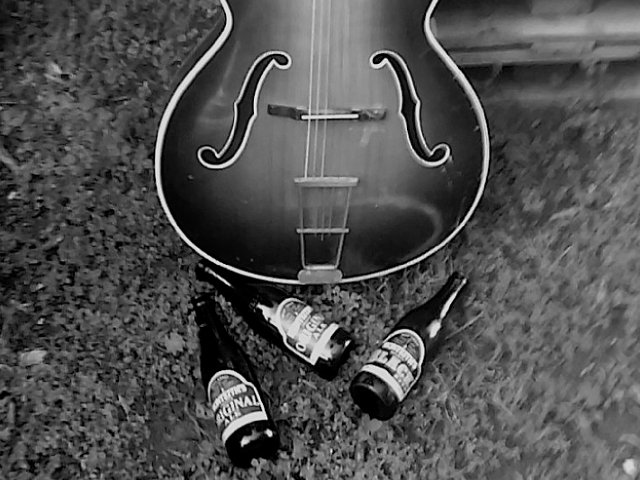
Above: Another successful evening spent composing music.
For me, music has always been emotional rather than cerebral. But, over the course of our Friday night Monteith's sessions, I've tried to analyse my musical emotions. Curiously -- and I am rather loathe to admit this -- I suspect that one of my formative influences has been that much-despised musical form: the New Zealand Bush Band.
Not, I hasten to add, that I want to break out a washboard or 'the spoons' -- but I must admit that there was something in the Bush Bands that I heard as a lad (they were in their twilight years during my early childhood) that resonated with me. A comfortable looseness in playing; a pleasant degree of unpolishedness; an almost unfamiliar New Zealand perspective and vernacular.
And incidentally, I'm quite convinced that some of my favourite Australian bands -- Nick Cave and the Bad Seeds, for example -- have taken some influence (perhaps subconsciously) from the distinct bush band music of their own country.
Eventually -- and possibly as a result of spending too much time around German artists -- I wrote down my thoughts in the form of a musical manifesto. Though I say so myself, it's a pretty good manifesto; and Blair only disagrees with about half of it. Luckily for me, he is an easy-going character, and contents himself merely by occasionally murmuring: "Do we really need to write this down?" and "Don't you think a manifesto is, y'know, a bit rigid?"
None of this, of course, was intended for public consumption. But it so happened that I sent one of our beerier recordings to l.e.d.s fan, Russell Brown, just so he could hear what the l.e.d.s keyboardist got up to on his days off. To my astonishment, Russell declared that he loved the song, and expressed a wish to hear some more. He even went so far as to suggest that it should reach a wider audience.
Naturally, such a suggestion was anathema to Blair and me. Didn't Russell comprehend the concept of music merely as a means of private expression? Didn't he understand that we were sensitive artists -- who shouldn't have our talents brutally exposed to the hoi polloi? Didn't he realize that his suggestion was a betrayal of everything that our music stood for?
"Well, I could pay you in beer," replied Russell.
And so here we are.
The E.P. of music presented herein is performed and recorded according to our (slightly disputed) manifesto. In short:
- Playing should emphasize feeling rather than slickness.
- Songs should be simple, brief, and to the point.
- Recordings should be performed as live, and technology should not be used to hide the inadequacies of the musicians; but rather to reproduce -- as honestly as possible -- what a listener would have heard in the room as the tape (or rather, bytes) rolled.
As a consequence of the above, some of these recordings are more Monteithsy than others. In fact, some of them are nearly all Monteith's, and only a little bit musical. We admit that the singing on the song 'I Found Out', for example, is almost exclusively Monteith's.
The project is called, for obvious reasons, Bridle Path. As I mentioned before, none of this music was ever intended for public consumption, and will certainly not be to the majority of people's taste. But, at the very least, for those -- like me -- who have followed Blair Parkes's career, it will be an interesting view on a completely different side of his musical talents. You certainly couldn't mistake it for the electronica of the l.e.d.s.
Many thanks to Russell Brown and Monteith's Breweries for providing the raw materials to lubricate these recordings.
Download the 'Monteith's Sessions E.P.' as a ZIP file with MP3s and cover art (7.8MB) [right-click on the link and choose "Save Target As..."]
or:
Click here to listen to streaming audio of the 'Monteith's Sessions E.P.' on the Bridle Path MySpace page.
[Note: The E.P. is free to copy and distribute, but it is copyright, and Bridle Path assert their moral right to be identified as the author(s).]
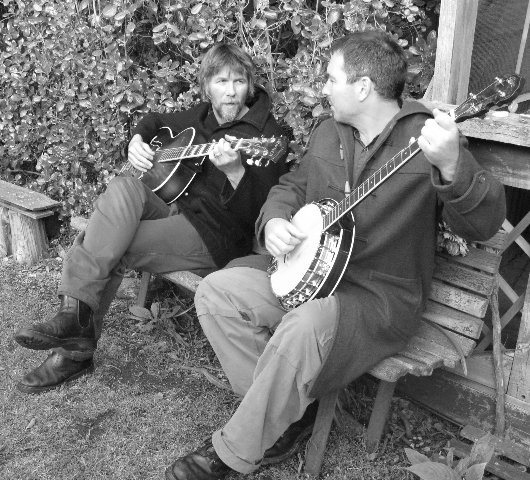
Above: Bridle Path in action.
Still a Scientist at Heart | Nov 03, 2009 20:19
- Hypothesis
- That the beehive-looking thing on the lawn isn't actually a beehive.
- Apparatus
- Beehive-looking thing.
- Lawnmower.
- Beehive-looking thing.
- Method
- Apply lawnmower to beehive-looking thing.
- Results
- Bees!
- Bees!
- Conclusions
- Bees don't like to be mown.
- Despite my advanced years, I am still faster than 90 per cent of bees.
- Ten per cent of a hive of bees is still quite a lot of bees.
- Even as an adult, bee-stings are surprisingly painful.
- Bees don't like to be mown.
Page 48 of 57
Archive


